
10th century
location: 42.056571121222724, 45.099618315855324
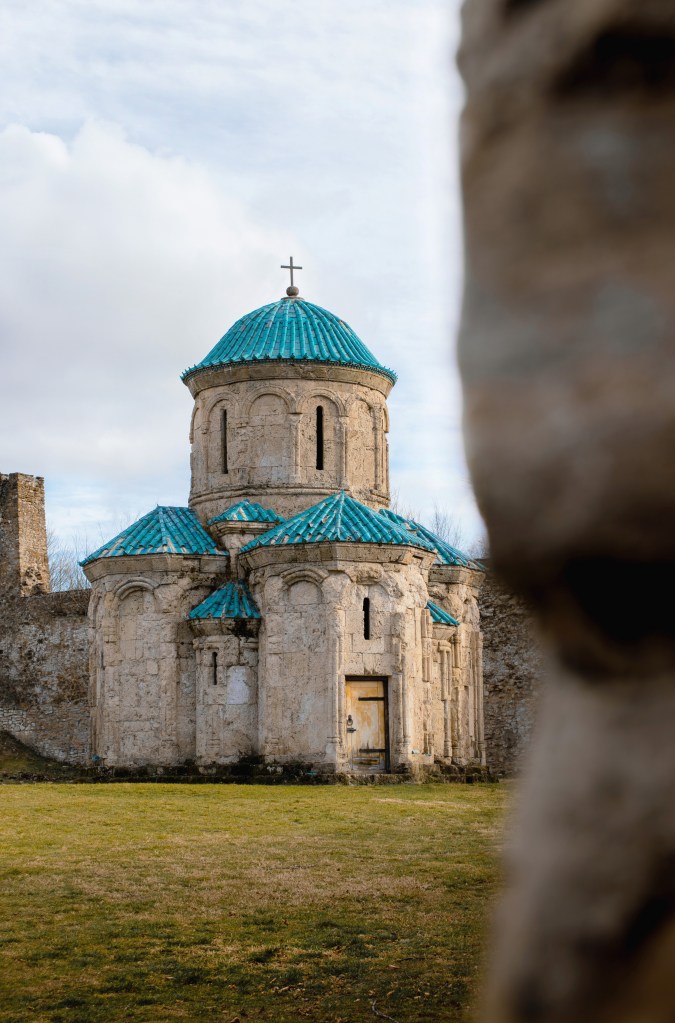
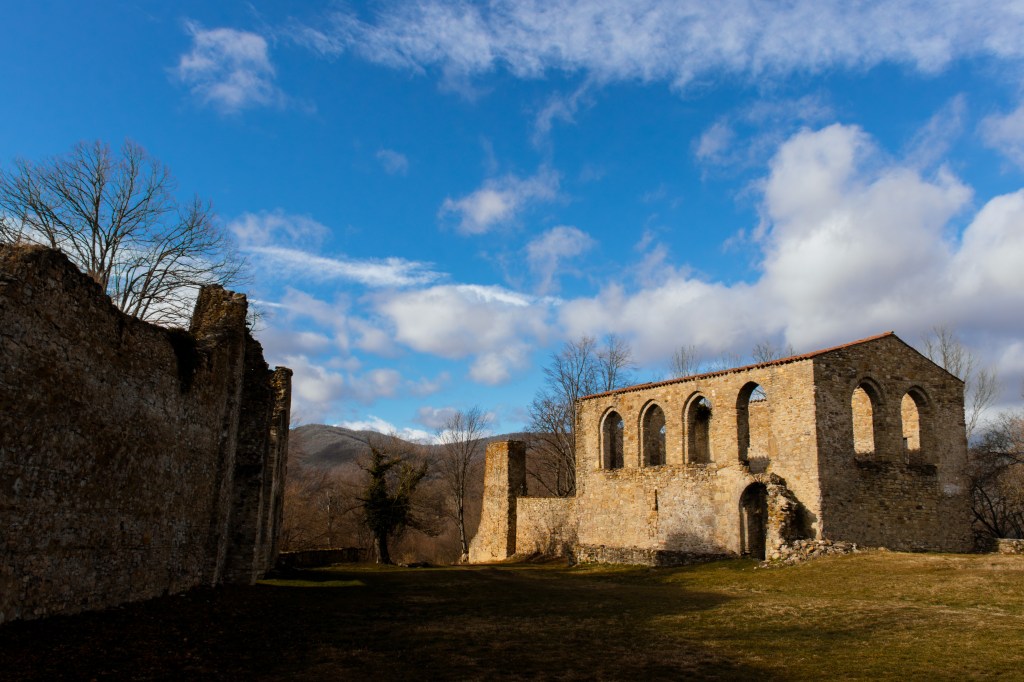
The church is located on a hill within the remains of the fortified complex of Kvetera, in Kakheti, Telavi district. In the 10th–11th centuries it was an important stronghold of the Kingdom of Kakheti. The church with its distinctive architecture, together with the palatial buildings nearby, indicate not only the importance of the fortress itself, but also the significance of the status of Kakheti as a separate unity at that time, before the formation of the Kingdom of Georgia (1008-1490).
The exact date of the construction of the church of Kvetera is unknown, but it is more likely that it was built in the first half of the 10th century. It is characterized by its distinctive compact symmetrical structure. The church has a tetraconch design – a domed structure with four apses symmetrically arranged around the central space. However, in contrast to the famous Jvari tetraconch, there are no chambers between the main apses, only four three-quarter niches. It rather resembles the structure of a small domed church in the Dzveli Shuamta monastery. Despite its small size, the church has two entrances, one from the south and one from the west.
The church has no frescoes or carved reliefs. Instead, it has architectural decorations incorporated into the structural elements of the building. The central dome with 6 small windows is supported by pendentives that gracefully transition from the square base to the circular drum. The windows were designed to create a specific visual effect of light and shadow, being very small on the outside but much larger on the inside.
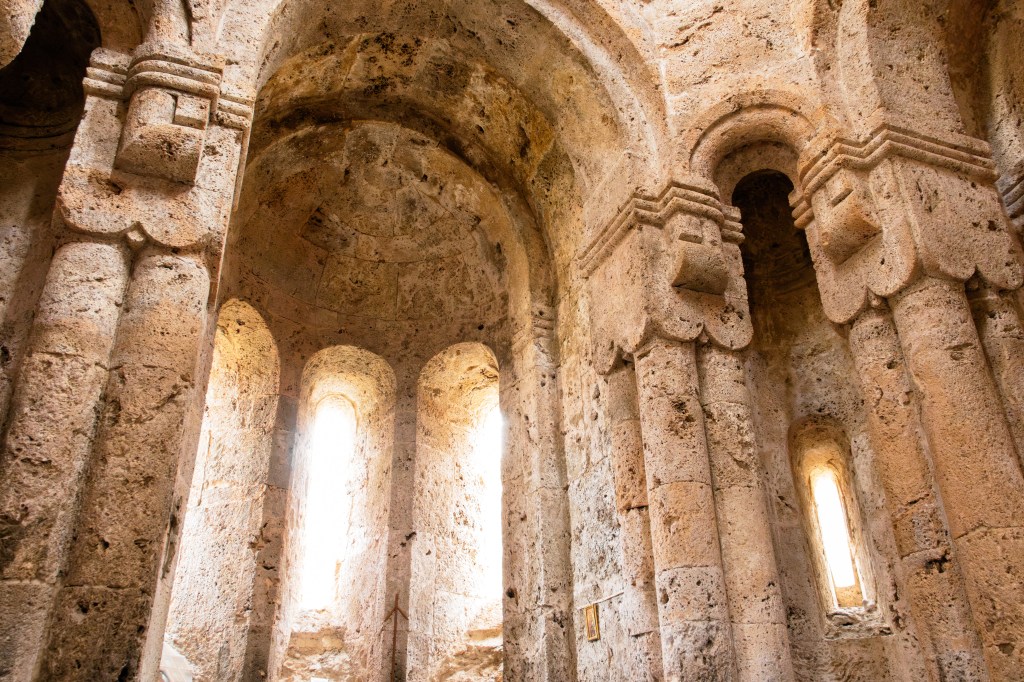
The transition from the dome is made with arches of different heights: large arches in the apses are higher than the narrow arches in the niches. Above these two levels of arches and actually between them, i.e. connecting the arches above the niches and the arches above the apses, there is another level of decorative arches, which creates a clear transition to the dome drum. Although this system of arches has a clear structural function, it creates a kind of decorative belt that contributes to the specific rhythm of the interior space of the church.
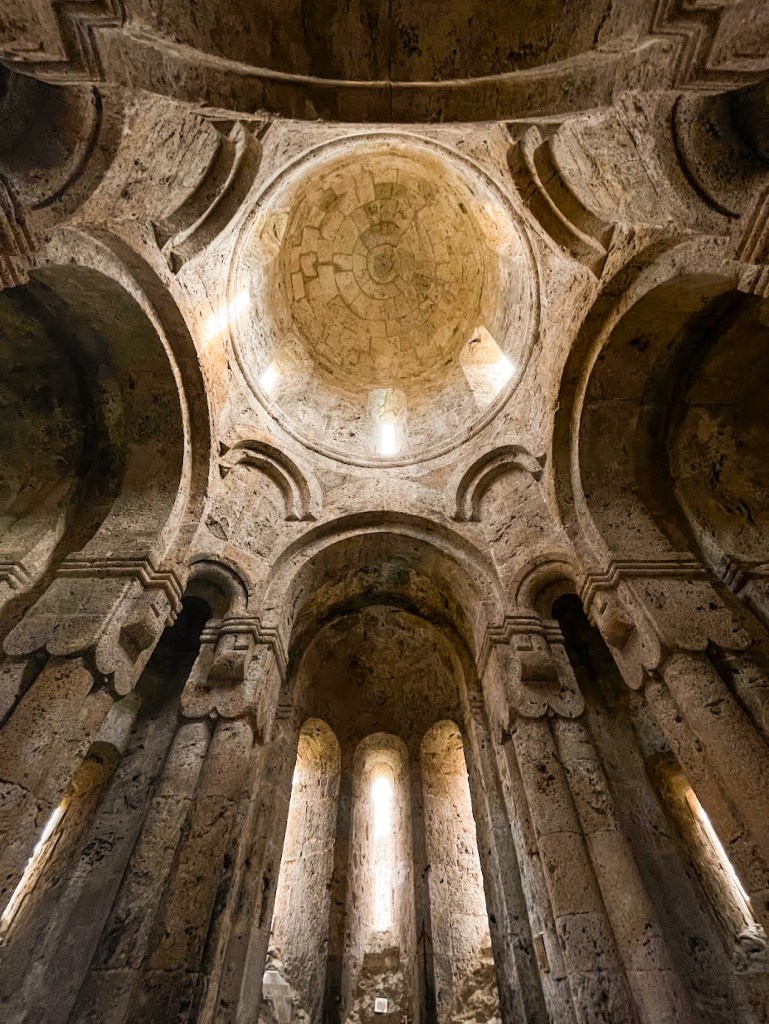
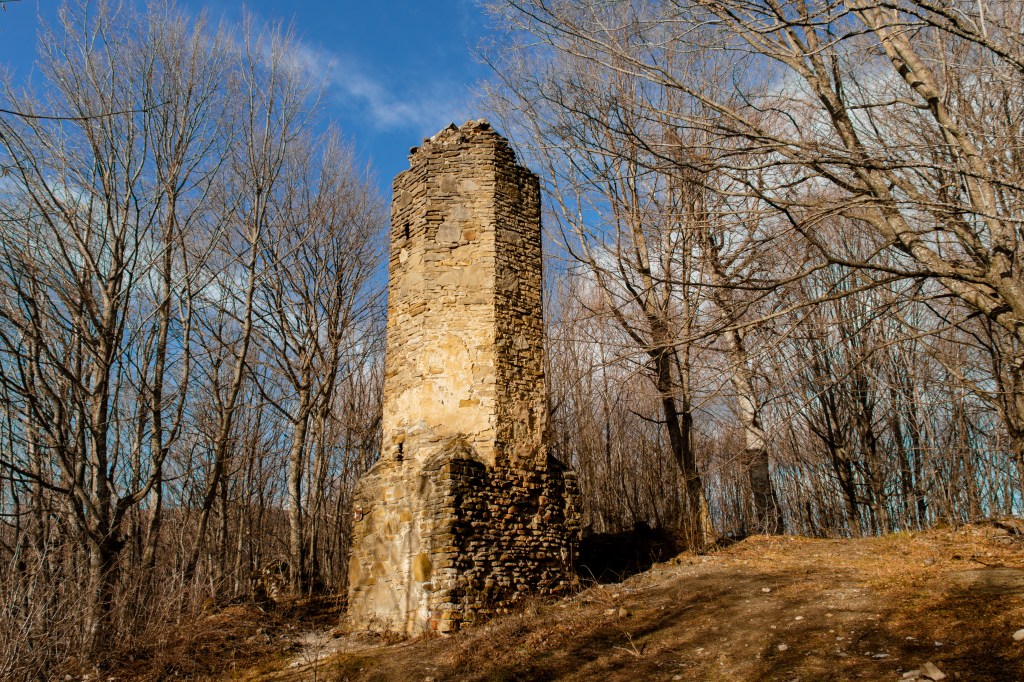
Since the whole Kvetera area was abandoned for centuries, it became forested, causing considerable damage to the exterior of the church. However, one can still clearly discern its architectural details.
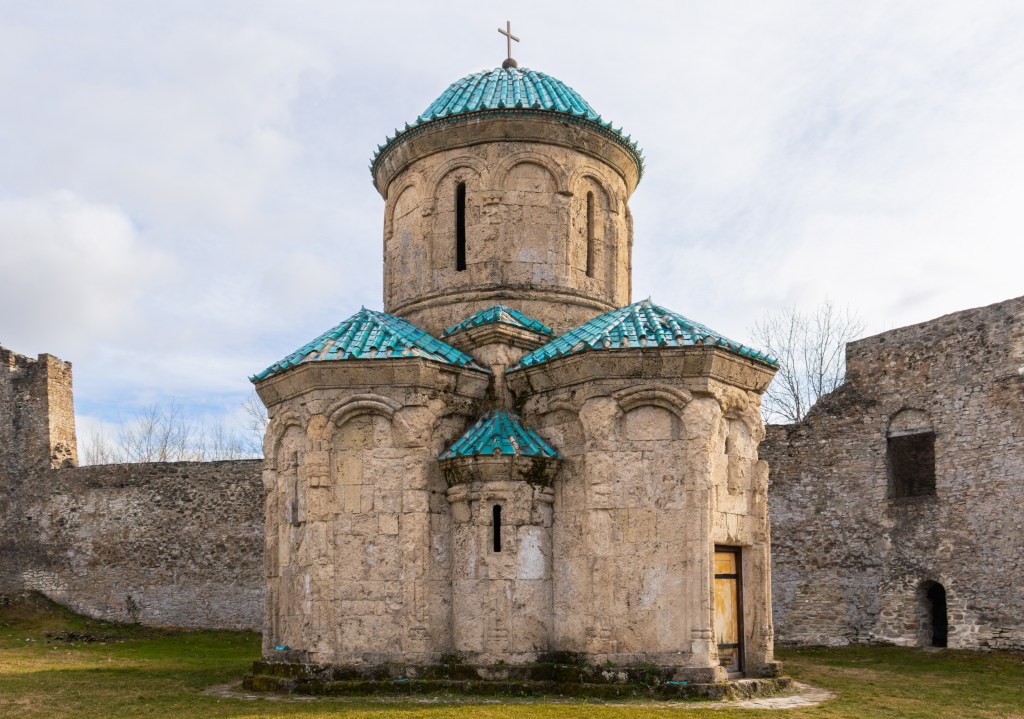
The church is made of locally quarried tuff stone shirimi and roofed with blue glazed tiles. From the outside, the apses are pentagonal. This pentagonality is defined in the corners of each apse facet by bundles of three semicolumns from which arches are thrown. All the interior parts project outwards, so that the structure of the church with its square central bay, four apses and four niches can be clearly seen, although some elements are too small due to the overall size of the church.
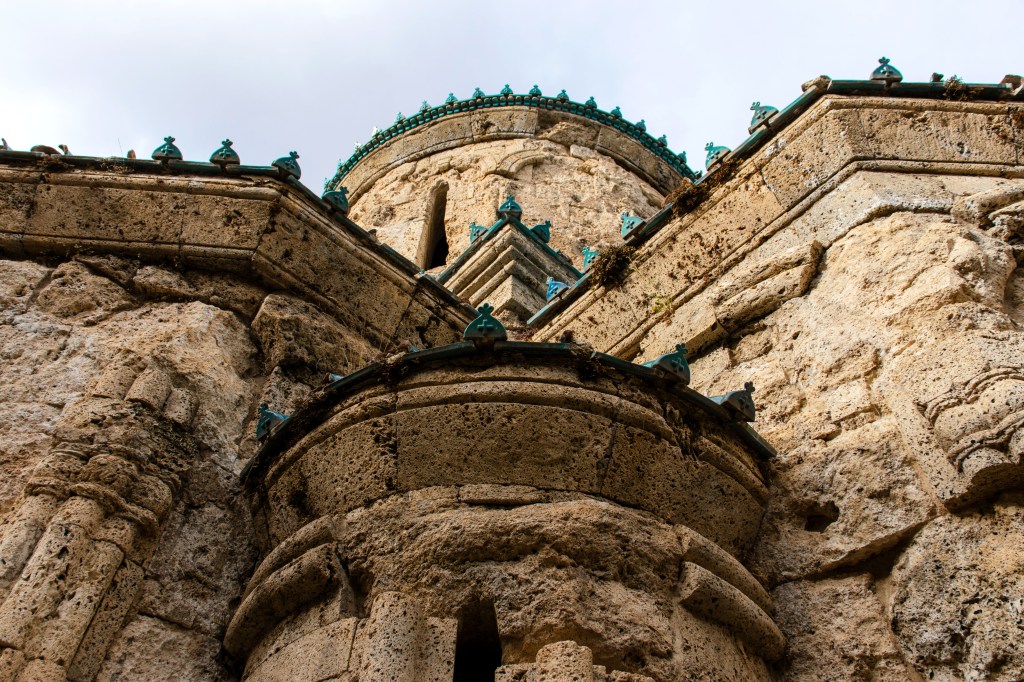
Since 2007, the Kvetera Church has been included in the UNESCO Tentative List of World Heritage Sites.
Sources and Further Reading
Chubinashvili, G. N. Arkitektura Kakhetii [Architecture of Kakheti]. Tbilisi, 1959. [in Russian]
text and photos by Elena Lisitsyna
 bureau MARKA