
1010–1029
location: 41.84232158498079, 44.72095599680703
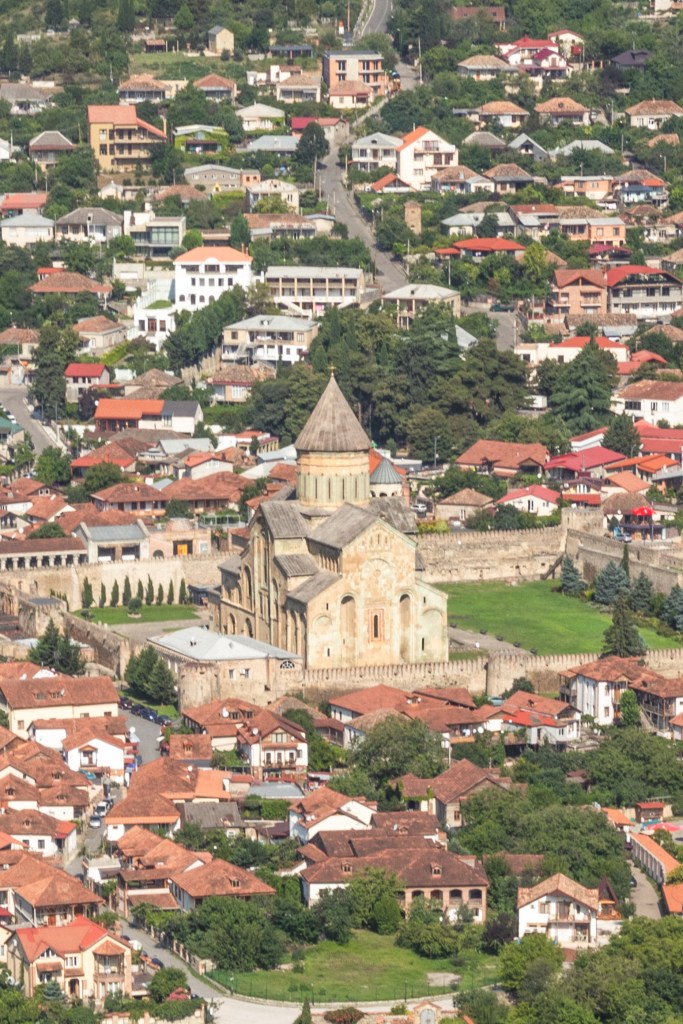
Svetitskhoveli is one of Georgia’s four Great Cathedrals, constructed during the 10th and 11th centuries. Alongside Oshki in Tao, Bagrati in Imereti, and Alaverdi in Kakheti, it represents the pinnacle of Georgian ecclesiastical architecture. The construction of these monumental churches coincided with the political unification and cultural flourishing of medieval Georgia.
The place of Svetitskhoveli construction — and actually the name of the cathedral — were not accidental. The site is associated with the legend of Saint Sidonia, who was buried holding Christ’s robe (chiton), brought to Mtskheta by a Georgian Jew, Elias. It is believed that a cedar tree grew over her grave, and its wood was used to create a pillar, that was believed to perform miracles. This pillar gave the name to the place — from Georgian, Svetitskhoveli means “Life-Giving Pillar”. The site has been a place of worship since the 4th century when King Mirian III and Queen Nana, following their conversion to Christianity by Saint Nino, built the first wooden church there, in 330s.
In the 480s, King Vakhtang Gorgasali replaced the wooden church with a stone basilica. Around the same time, the Byzantine government elevated the chief prelate of eastern Georgia (Kartli) to the rank of Catholicos, further solidifying Svetitskhoveli’s importance, as it was made the see of Georgian Catholicos. This 5th century basilica, resembling the Bolnisi Sioni church, had three naves and an apse projecting outside. Archaeological excavations during the 1968–1972 restorations uncovered remnants of both the original 4th century wooden church and this 5th-century stone basilica.
The cathedral we see today was built between 1010 and 1029 under the leadership of Catholicos Melchizedek I, believed to be the first to bear the title Catholicos-Patriarch of All Georgia, which remains in use. Mtskheta thus became Georgia’s religious capital, not only as the seat of the catholicos-patriarch but also as the site where nearly all Georgian kings were crowned.
Constructed from sandstone blocks, 11th century Svetitskhoveli cathedral features a rectangular ground plan with a slightly offset dome resting on four massive piers. The longitudinal walls and some piers of the earlier basilica were integrated into the new structure, parts of which remain visible today. The cathedral’s spatial arrangement is intricate, combining the hierarchy of a basilica with the symmetry of a cross-domed church. From a ground-level view, the layout resembles a three-nave basilica with a higher central nave, intersected by arms of equal height. Thus, viewed from above, it reveals a cross-shaped plan. This hierarchical design is further accentuated by the exterior’s architectural ornamentation. Blind arcading decorates the walls, with the arches rising and falling in harmony with the facade’s varying heights.
The cathedral’s status is emphasized by its large altar, which features seventeen arched seating niches for clergy and a chancel bay for the catholicos-patriarch and bishops. Flanking the main apse are two chapels with their own apses, recessed within the walls but distinguishable externally by sharply defined niches — a hallmark of medieval Georgian church architecture. The cathedral also contains upper-storey rooms and concealed spaces accessible from the southern nave.
While Svetitskhoveli’s 11th century structure remains largely intact, it has undergone significant modifications due to damage and subsequent restorations. In 1400, it was heavily damaged by Tamerlane’s forces, especially the western part, which was restored under King Alexander I the Great (1412–1442). Alexander, who prioritized the repair of churches, even imposed a special tax to fund Svetitskhoveli’s restoration. During this phase, the western gallery was altered: the original three pairs of arches were reduced to two, and a room was added in the western upper part instead of the U-shape upper gallery situated on wester, southern and northern sides earlier. Later, an earthquake in 1656 caused the dome’s collapse, though it was soon rebuilt.
The cathedral’s exteriors are richly adorned with intricate carvings of animals, floral motifs, geometric patterns, and inscriptions in the Asomtavruli script. The eastern facade retains particularly elaborate ornamentation, including a window framed with dark red stone and topped by a relief of twelve radiating figures in a fan form. A similar relief, featuring an eagle at its center, is located on the northern facade.
Svetitskhoveli is also notable for identifying its builder — an unusual feature among medieval Georgian churches, where master architects often remained anonymous. A relief on the northern wall depicts a right hand holding an L-square (a stonemason’s tool), accompanied by an inscription reading, “The Hand of Arsukidze, slave of God, may forgiveness be his.” Another inscription on the eastern facade references both Arsukidze and Catholicos Melchizedek I, suggesting Arsukidze was the chief architect of the cathedral as there is no other historical evidence on this person.
The cathedral’s interior is striking for its atmosphere of grandeur, accentuated by frescoes. While many original murals were lost — notably, some during preparations for Emperor Nicholas I’d visit, in 1830, when sections were whitewashed — restorations have revealed frescoes, most of them are from the 16th–18th centuries. Particularly noteworthy is the large Apocalypsecycle on the southern nave wall and the 17th-century Catholicos’ Cathedra and the 17th-century ciborium, the latter protecting the revered Life-Giving Pillar.
Together with the marvellous pillar, Svetitskhoveli holds numerous sacred and historical relics. In the southwest corner stands a 13th–14th-century replica of the Chapel of the Holy Sepulchre in Jerusalem, linking the cathedral — as the burial site of Christ’s robe — to the Holy Land. Additionally, Svetitskhoveli serves as the final resting place for prominent Georgian kings, including Vakhtang Gorgasali and Erekle II.
The present cathedral complex includes an 18th century defensive wall with corner towers. The arched western gate, dating to the 11th century, aligns with the cathedral’s construction.
Today, Svetitskhoveli remains a vital part of Georgia’s cultural and religious heritage. Together with Jvari and Samtavro monasteries, it is recognized as a UNESCO World Heritage Site, in 1994.
Sources and Further Reading
Khoshtaria, D. Medieval Georgian Churches: A Concise Overview of Architecture. Tbilisi, 2023.
Rapp, Stephen H. Jr. (2007). “Georgian Christianity.” The Blackwell Companion to Eastern Christianity. John Wiley & Sons, pp. 137–155.
Tsintsadze, V. Nekotorye osobennosti bazilik rannekhristianskoi Gruzii i arkhitektura baziliki V veka Sveti-Tskhoveli v Mtskheta [Some Features of Early Christian Georgian Basilicas and the Architecture of the 5th-Century Svetitskhoveli Basilica in Mtskheta], in: Ars Georgica 10 (1991), 17–50. [in Russian]
 bureau MARKA