
also known as Kalantarov House
location: 41.68972848786815, 44.79974772157294
architect: Ghazar Sarkisyan
date: 1908
If you would like to learn more about Sololaki, our partner FAHU travel offers a walking tour of the district with historical entrance halls and a visit to an early 20th-century apartment; more details here.
17 Ivane Machabeli Street – the Kalantarov House – sets an Orientalist accent in Sololaki’s late-imperial street wall. Built in 1908 for the merchant M. Kalantarov to designs by the Tbilisi-based architect Ghazar (Lazar) Sarkisyan, the corner plot reads with two addresses (Machabeli 17 / Asatiani 27). Kalantarov’s ethnicity is not documented; the surname is widespread among Armenians, but no primary evidence has been located.
The commission sits within nineteenth-century eclecticism in Europe and the Russian Empire, where historicist “pseudo-styles” were treated as a repertory of effects rather than doctrines. Orientalist sets – horseshoe arches, muqarnas, patterned ceilings – circulated via pattern books and workshop practice, shifting from theatres and exhibition halls into revenue houses and club interiors. The Kalantarov house is a clear case of this finish-as-sign economy in late-imperial urban life.
Outside, the program is stated without excess. Along Machabeli and Asatiani the wall is horizontally banded in rustication; window bays are set in smooth, right-angled frames and finished with keyhole/horse-shoe archivolts. The perimeter cornice is corbelled with a shallow blind-arcade frieze. The corner is marked by a semicircular bay and a deep balcony borne on a shell-shaped console and capped by a small dome.
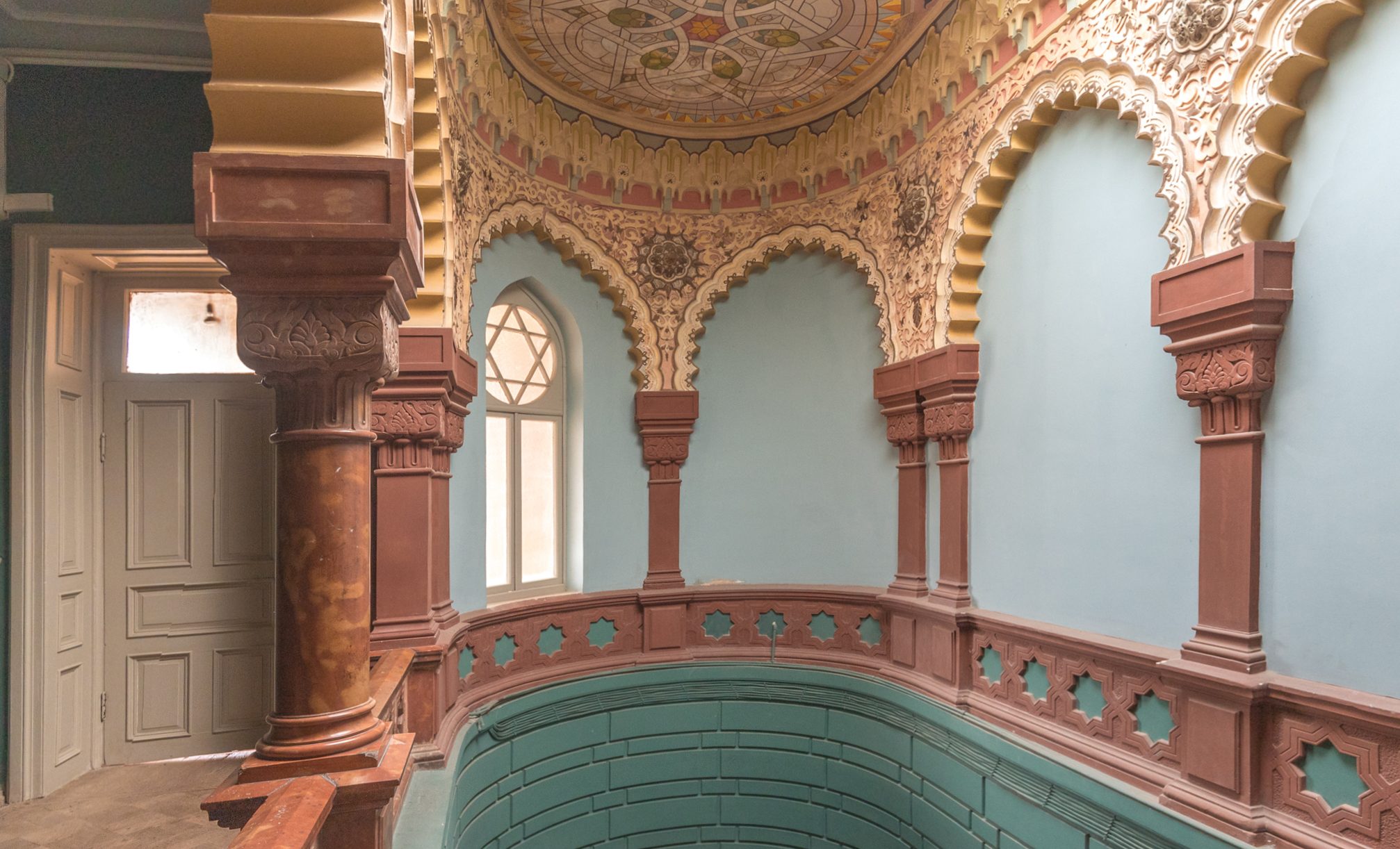
The entrance – our illustration – concentrates the ensemble. Here the “relief-plus-paint” composition replaces Tbilisi’s more typical fully painted halls. At the landing and in the soffits, transition zones are built up in muqarnas: tiered, faceted cells stepping down from the wall line – a volumetric treatment distinct from the exterior’s flat frieze. Pointed arches, framed panels and doorheads are modelled in deep plaster and then painted. The palette is deliberately Orientalist – warm terracotta grounds against bottle-green/teal fields with cream and brick-red accents – tightened by a small stained-glass oculus that pools color at the landing.
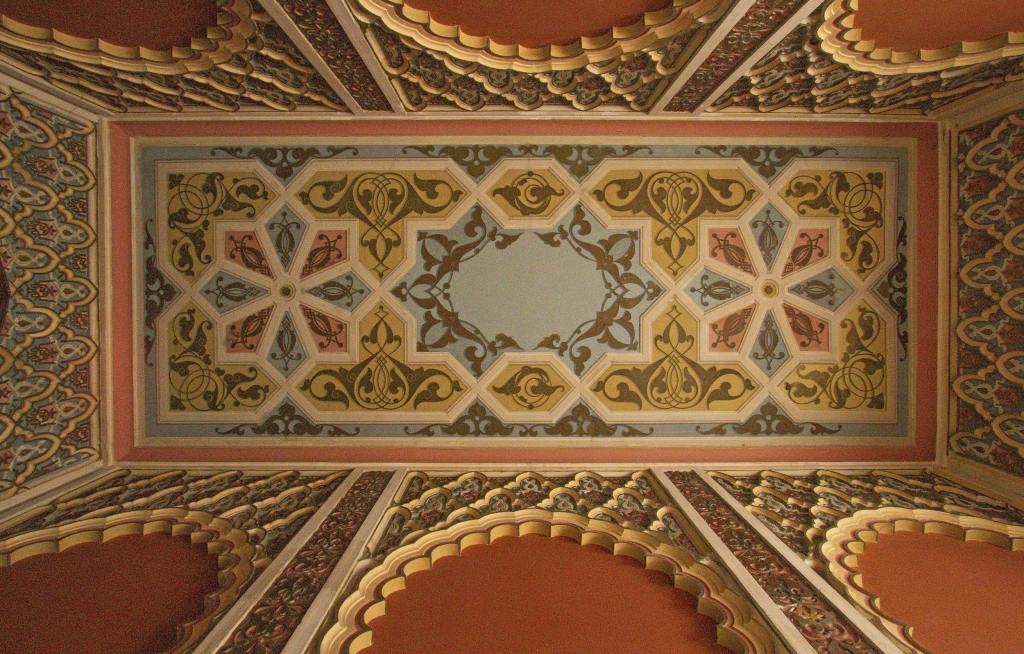
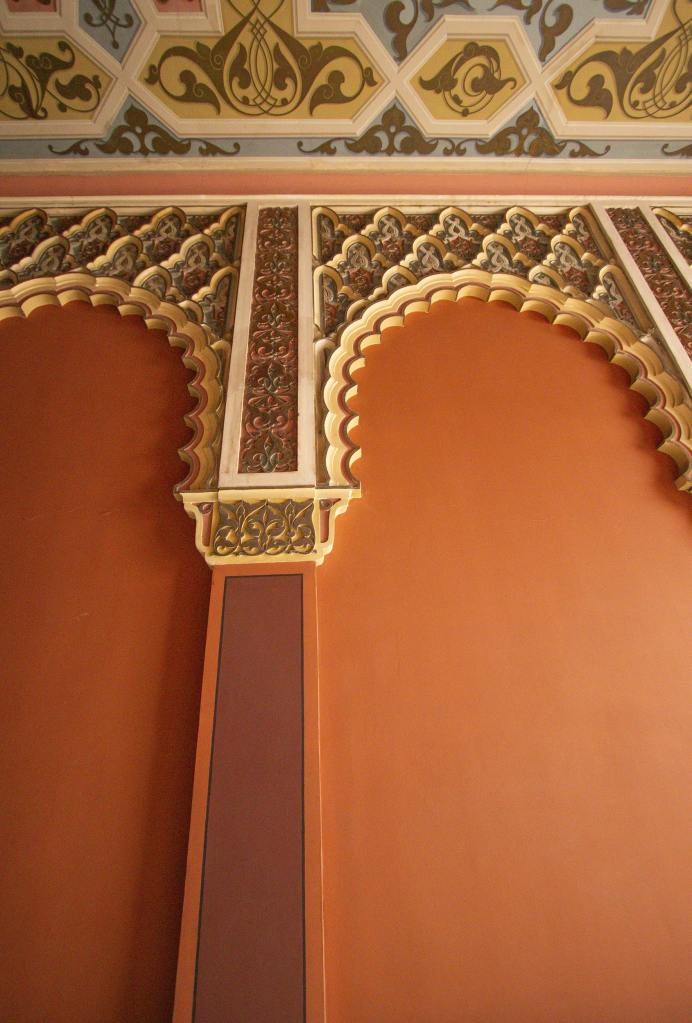
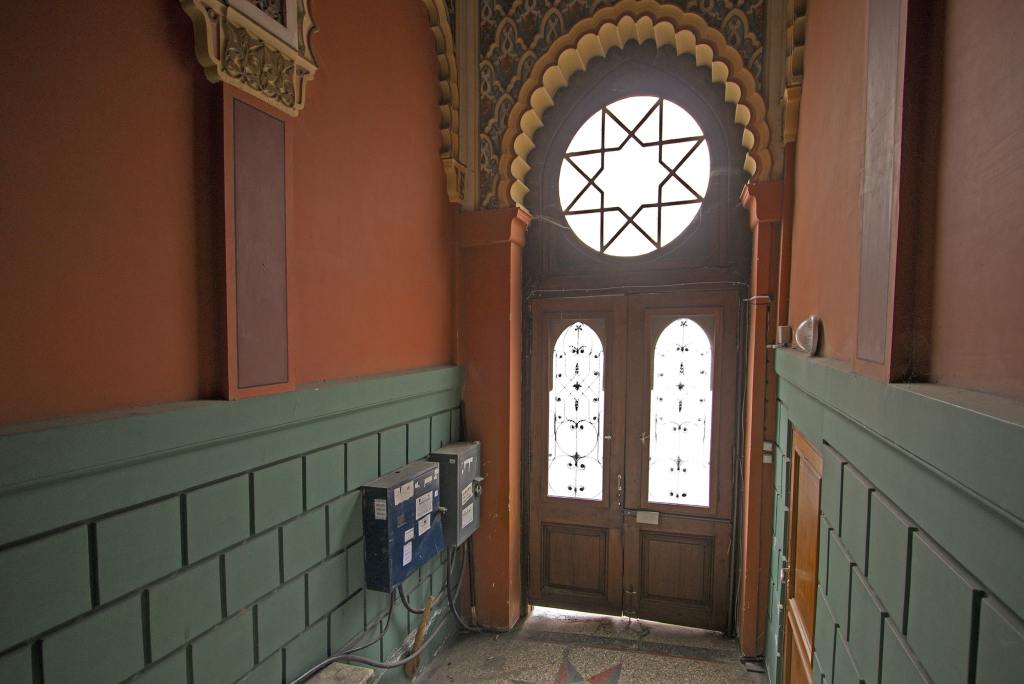
Read against the city’s touchstones, the address is legible without overstatement. At civic scale, the Opera on Rustaveli Avenue is the canonical Moorish-Revival envelope and interior; the City Assembly on Freedom Square shows a Neo-Moorish mask. Within this map the Kalantarov House demonstrates how a residential property internalised and distributed the style across façade, threshold, and courtyard.
As for the present state of the house, recent cleaning and repair have stabilized the decoration. However, as the property is private, access to the stair is limited, and the entrance remains difficult to view without arrangement.
Sources and Further Reading
Beridze, Vakhtang. Architecture of Tbilisi, 1801–1917, 2 vols. [tbilisis khurotmodzghvreba, 1801–1917]. Tbilisi, 1960–1963. [in Georgian].
Chanishvili, Nino. Nineteenth-Century Architecture of Tbilisi as a Reflection of Cultural and Social History of the City. FaRiG Rothschild Research Grant Report, 2007.
Kvirkvelia, Tengiz. Old Tbilisi [dzveli tbilisi]. Tbilisi, 1984. [in Georgian].
Kutateladze, Tea. Interiors of Residential and Public Buildings in Tbilisi, 19th–20th Centuries [satskhovrebeli da sazogadoebrivi shenobebis int’erierebis monument’ur-dek’orat’iuli perts’era k. tbilisshi XIX-XX sauk’uneebis mijnaze]. Tbilisi, 2015. [in Georgian].
Meskhi, Maia. Architectural-feature Analysis, Problems and Paradigms of Sololaki Area’s Spatial-Volumetric Structure [sololak’is sivrtsit – motsulobiti st’rukt’uris arkit’ekt’urul – mkhat’vruli analizi, problemebi da paradigmebi. Tbilisi, 2019. [in Georgian].
Wheeler, Angela. Architectural Guide: Tbilisi. 2023.
text by Elena Lisitsyna
photos by Faig Huseynov and Elena Lisitsyna
 bureau MARKA