
also known as Lermontov House
location: 41.69132844410401, 44.80350789449249
date: 1880s
illustration focus: street facade; carved balcony (ayvani)
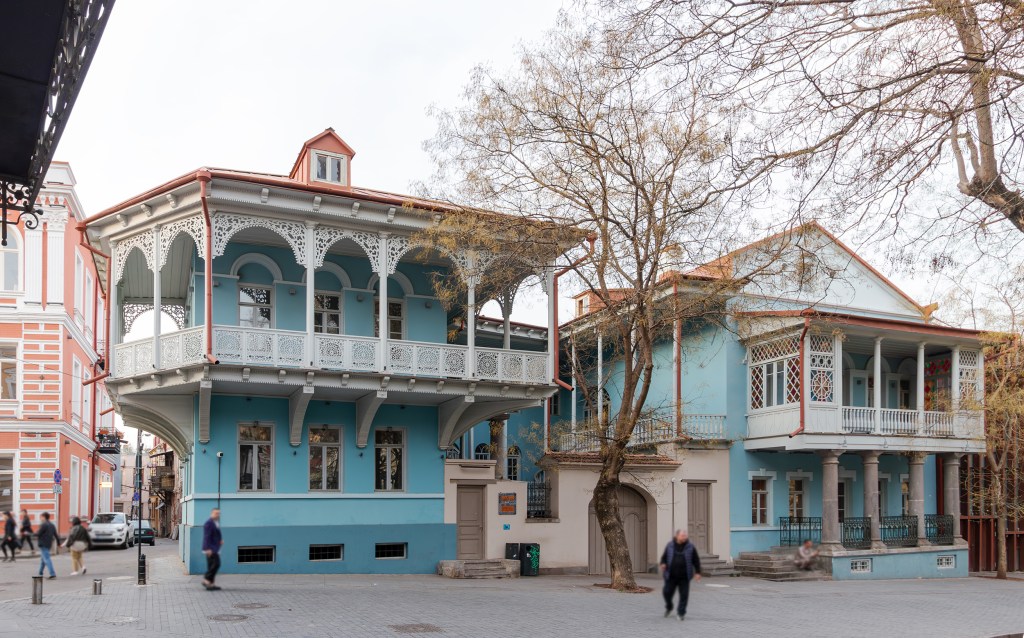
Gudiashvili Square Area
Gudiashvili Square sits exactly where Kala’s medieval fabric meets Sololaki’s 19th-century grid. In the mid-18th century the site of today’s green was the orchard of the merchant brothers Nazarbegh and Bejan—hence the toponym Bejanas Baghi (“Bejan’s garden”). Later it was known as Mogninskaya, after the nearby Armenian Church of Saint Gevorg of Mughni. In 1828 the small market space that had formed here was named Abbas-Abadskaya to commemorate General Ivan Paskevich’s capture of the Persian fortress Abbas-Abad (1827). In 1923 the square was retitled for the Bolshevik Stepan Alaverdov; since 1988 it has borne the name of the painter Lado Gudiashvili.
Socially and spatially this was always a prosperous address: a merchant quarter where two- to three-storey dwellings frame a small civic room. Eleven perimeter buildings of broadly similar height still define the square; most date to the late 19th – early 20th century, with a few later inserts now reconstructed. The district crystallised Tbilisi’s 19th century blend of European street manners and local craft: façades aligned to the pavement, restrained plaster fields, and distinctive timber galleries projected to the public side. The planted square itself is an imperial-era creation, laid out in 1908–1910 to designs by the botanist Heinrich Karl Werner Scherrer and the architect Aleksandr Melik-Beglarov.
House No. 2: Architecture
House No. 2 is unusual in plan: a horizontally stretched U-shaped (П-shaped) courtyard house that opens toward the street. It grew in stages. The right-hand half is generally read as the classicising core: a centred, post-carried gallery across the middle third of the façade, with broad rectangular windows and early-type archivolts behind. Whereas classical columns were typically stone, here the “order” is translated into wood. On the second level a small street balcony is enclosed with ornamented stained glass—and, breaking strict classicist rules, it projects laterally beyond the lower colonnade.
The courtyard reads as a semi-public room. Three sides are lined with a light wooden colonnade, while the street edge is held by a brick screen wall up to first-floor height. An opening fitted with an openwork iron grille keeps the yard visually open: from the street you glimpse the inner gallery, its very elongated timber posts “strung” between the two levels. These slender uprights – typical of Tbilisi gallery practice of the late 19th century – play against the site’s heavier notes: the masonry fence, the stout stone pier by the gate, the massive corner columns, and the broad, horizontally stretched composition of the whole house.
The left-hand half completes the U-shape. It keeps the same structure but grows livelier in wood: the famous corner balcony with carved balustrade and upper arches, small consoles, scalloped rail ends, and shallow arches between posts. In effect, a calm classicising wall (plastered brick, flat-arched windows, low base, simple cornice) is “rewritten” in timber and tipped toward an eastern-tinged filigree.
The defining feature of the left-hand part — and of the building as a whole — is the ayvani. In everyday terms it’s a balcony; here it is a shallow wooden gallery that projects to the street and works as a lived threshold: shade in summer, a place to sit, talk, and watch the square. In 19th century Tbilisi such front-facing gallery became a hallmark. Even as facades followed European rules, the ayvani stayed on the street side, keeping everyday life visible.
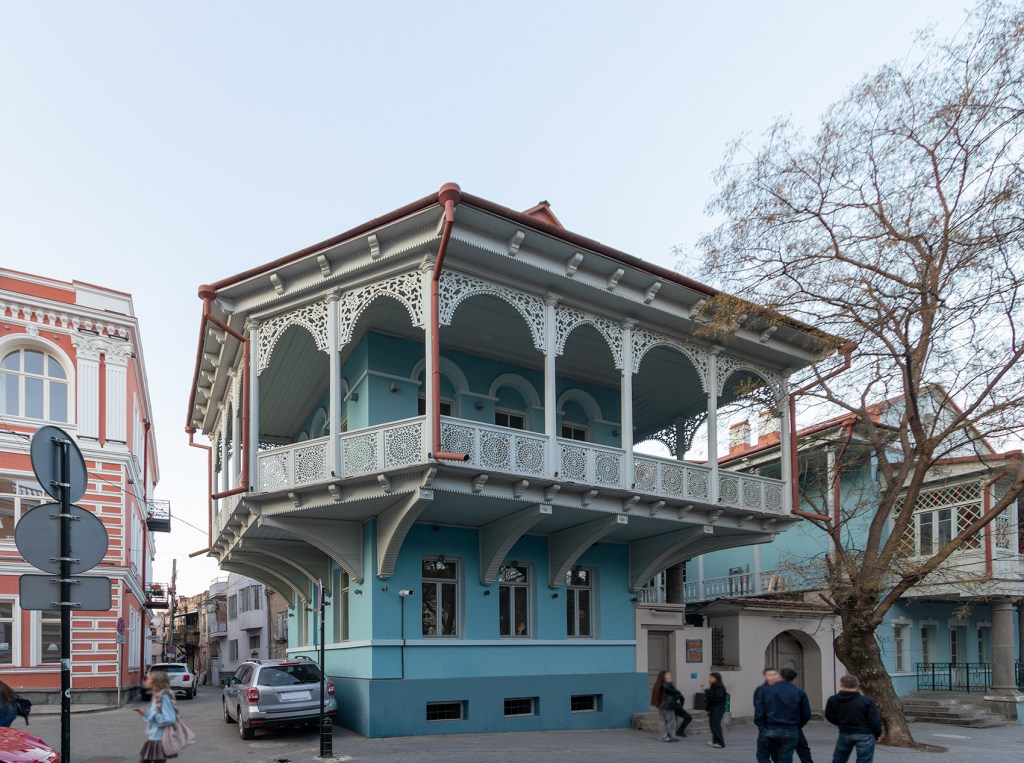
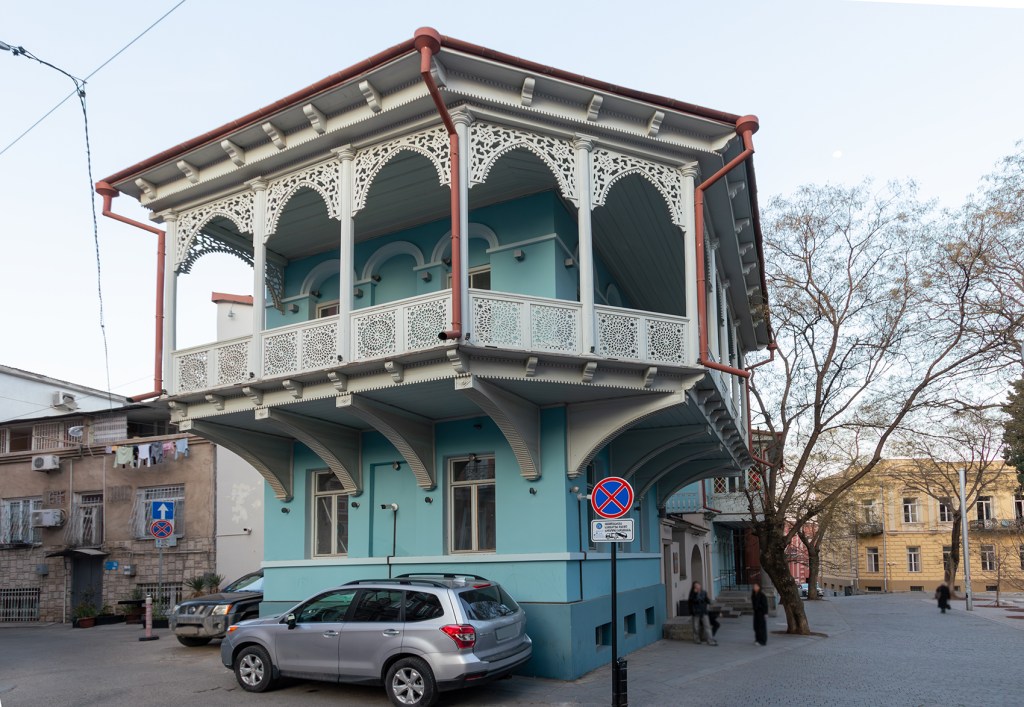
Structurally, the ayvani is a light porch frame. Slim posts stand on small plinths; between them runs a handrail and balustrade with openwork (ajour) panels, and above, carved arches span from post to post. These pierced panels echo wider Islamic lattice traditions via the mixed craft culture of Tbilisi workshops. They drew on several streams: local Georgian carpentry, Armenian and Azerbaijani urban traditions, and patterns circulating from the Persian and Ottoman worlds. The result isn’t a mashrabiya (that’s a projecting box-oriel with dense lattice in Arab architecture), but a Tbilisi variant: it remains a flat, post-and-beam gallery that engages the street. In early-imperial terms, it is classical composition recast in timber: colonnades made slimmer, with room for lace-like infill and small arches. As the 19th century advanced, ironwork began to replace wood on some principal façades, and later “regularisation” often dulled earlier hand-cut profiles.
A quick way to read the ayvani today: older fabric feels slightly thicker and irregular (denser grain, softer-edged handrails, small variations in spindle spacing). Newer pieces look paler, slimmer, and very even. After the 2002 earthquake there were spot replacements; the halted works of 2011–2012 left partial swaps; and in the 2018–2020 rehabilitation the gallery was renewed more systematically—slimmer rails, machine-regular spindle rhythm, some simplified or reglazed corner panels. Because the ayvani carries the whole composition, these small shifts in section and cadence change how the front reads.
House No. 2: History of Use and Restoration
19th century records tie the property (namely its right part) to the imperial military administration: ground-floor offices with an officers’ lodging above. This underpins the house’s long-lived association with the poet and army officer Mikhail Lermontov, who spent a short period in Tbilisi in 1837; whether he personally lodged here is unknown, but officers did, and the label stuck. Later ownership passes through the merchant Amirov family: in 1885 the brothers Sergei, Egor, and Isaiah Amirov held the house; in 1908 Isaiah’s daughter Elizaveta became owner; after her 1912 marriage it passed to her daughter, Anastasia Ezhubova (Georgievna). In the Soviet era the square-side rooms housed the editorial office of Literaturuli Sakartvelo (notably in the 1970s and again in the 1990s).
The 2000s–2010s brought disruption and renewal. The 2002 earthquake affected low-rise masonry in Old Tbilisi most severely, prompting emergency shoring across the historic quarters, including on Gudiashvili Square. In 2011–2012 a City Hall-backed commercial reconstruction triggered fencing, partial takedowns (including at the corner “Lermontov House”), and protests that halted demolition. The project was reframed as rehabilitation; by 2020 the landscape redesign (David Giorgadze; planting by Ruderal) was complete, and perimeter works mixed reinforcement, reconstructions, and new shells—explaining today’s blend of repaired fragments and replacements (and, at No. 2, more uniform joinery).
During the 2016–2023 campaign, archaeological excavations on and around the square confirmed continuous urban occupation since the Middle Ages, with especially dense 14th–18th-century layers beneath the present plots. After reconstruction, the perimeter houses — including No. 2 — returned with upgraded fabric but uneven occupancy: ground floors fill first with short-term commercial or cultural uses, while securing long-term residents for upper levels has proved harder.
Set within Tbilisi’s 19th century development of the Old Town and Sololaki area, House No. 2 at Gudiashvili Square reads as a touchstone. It shows how Tbilisi absorbed a classical order of the street front yet kept agency in wood—turning the colonnade into ayvani, slipping openwork between posts, and treating the balcony as a lived threshold rather than mere ornament. Conservation here is exacting: the facade’s legibility depends on the ayvani’s parts and proportions, and decisions at the scale of a rail or spindle register immediately in the square.
Sources and Further Reading
Anagi LLC. Reconstruction of Gudiashvili Square, Tbilisi (contractor project page). Available at: anagi.ge
Beridze, Vakhtang. Architecture of Tbilisi, 1801–1917, 2 vols. [tbilisis khurotmodzghvreba, 1801–1917]. Tbilisi, 1960–1963. [in Georgian]
Chubinashvili, Giorgi; Severov, Nikolai. Paths of Georgian Architecture [Puti gruzinskoi arkhitektury]. Tbilisi, 1936. [in Russian]
Kvirkvelia, Tengiz. Old Tbilisi [dzveli tbilisi]. Tbilisi, 1984. [in Georgian]
Kutateladze, Tea. Interiors of Residential and Public Buildings in Tbilisi, 19th–20th Centuries [satskhovrebeli da sazogadoebrivi shenobebis int’erierebis monument’ur-dek’orat’iuli perts’era k. tbilisshi XIX-XX sauk’uneebis mijnaze]. Tbilisi, 2015. [in Georgian].
Meskhi, Maia. Architectural-feature Analysis, Problems and Paradigms of Sololaki Area’s Spatial-Volumetric Structure [sololak’is sivrtsit – motsulobiti st’rukt’uris arkit’ekt’urul – mkhat’vruli analizi, problemebi da paradigmebi. Tbilisi, 2019. [in Georgian].
Tavadze, Tamar. House of Brothers Amirov (Amiryan) (online entry). Available at: metaport.ai
Tavadze, Tamar. History of the District (online entry). Available at: metaport.ai [in Russian]
Tbilisi Architecture Network (TAN). 2 Gudiashvili Square (online entry). Available at: tbilisiarchitecture.net
Tsintsadze, Vakhtang. Tbilisi: Architecture of the Old City and Residential Houses of the First Half of the 19th Century [Tbilisi. Arkhitektura starogo goroda i zhilye doma pervoi poloviny XIX stoletiia]. Tbilisi, 1958. [in Russian]
Wheeler, Angela. Architectural Guide: Tbilisi. Berlin, 2023.
text and photos by Elena Lisitsyna
 bureau MARKA