
also known as Ter-Akopova House
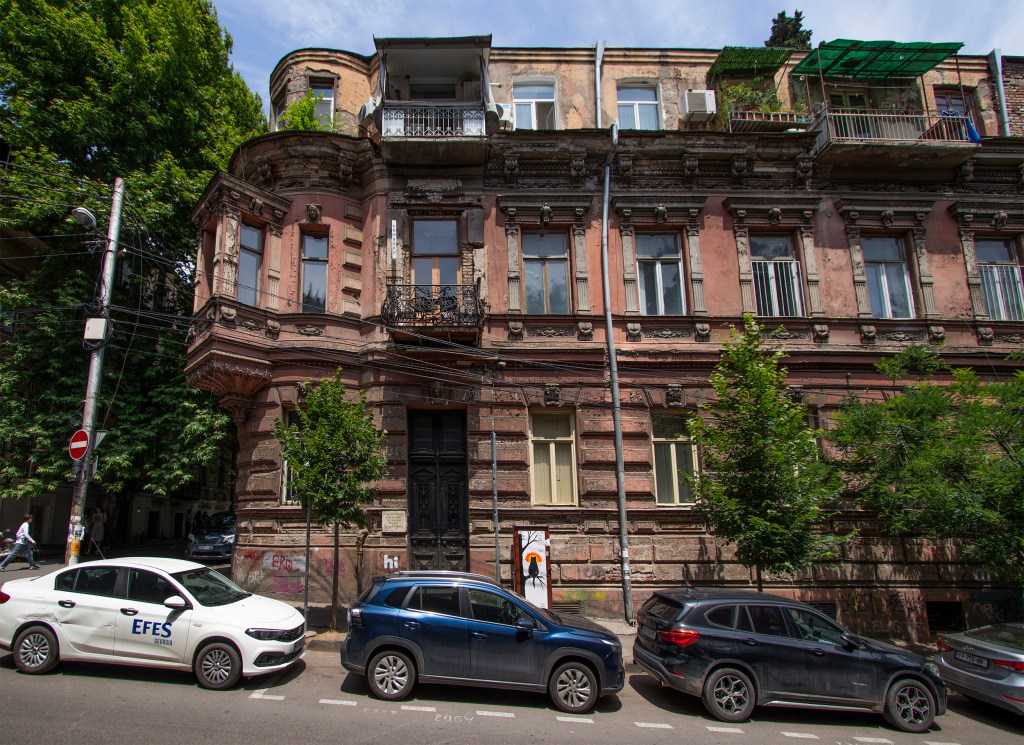
location: 41.689836052676824, 44.80155094348264
date: 1896
illustration focus: street facade, plasterwork
If you would like to learn more about Sololaki, our partner FAHU travel offers a walking tour of the district with historical entrance halls and a visit to an early 20th-century apartment; more details here.
24 Galaktion Tabidze Street – known as the Ter-Akopova House – condenses the Sololaki project into a single front: an income-producing tenement with a theatrical façade. The district formed on former gardens at the foot of the ridge and was regularised in the 1860s–1890s as a rectilinear grid of party-wall masonry with shops below and flats above. By 1900 its continuous cornice lines and decorated façades read as Tbilisi’s Europeanised extension. Socially, Sololaki consolidated as a bourgeois address: revenue houses and private mansions combined late-19th/early-20th century pseudo-styles with local craft. Here public fronts end official entrance halls largely demonstrated an “European” fashion vocabulary – regular bays, stucco décor, iron balconies. A substantial Armenian mercantile stratum – well attested in travel accounts and civic records for the long nineteenth century – underwrote much of this patronage and its taste for show facades.
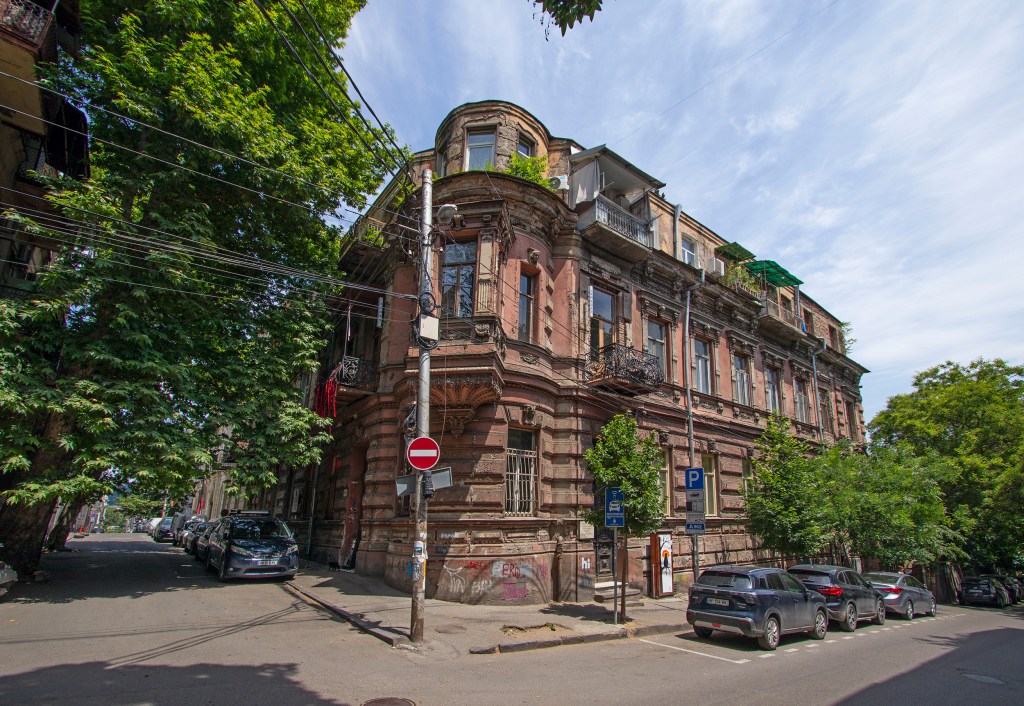
Within this frame, the house at no. 24 (then Ganovskaya Street) was conceived as an income house. It belonged to Evelina Ter-Akopova (a Russified form of Hakobyan), an ethnic Armenian and Tbilisi citizen. The street front is an eclectic late-19th century composition: rusticated base, enriched window surrounds, and sculptural stucco. Among the latter are mascarons – sculpted heads revived from Renaissance models and popularised by imperial eclecticism – which punctuate keystones and spandrels, turning the bay rhythm into an ornamental line. In Sololaki, such masks were a program rather than a whim: they signalled “European” literacy and prosperity, and, paired with foliage, consoles, and bracketed sills, knit the elevation into a continuous frieze readable at walking pace.
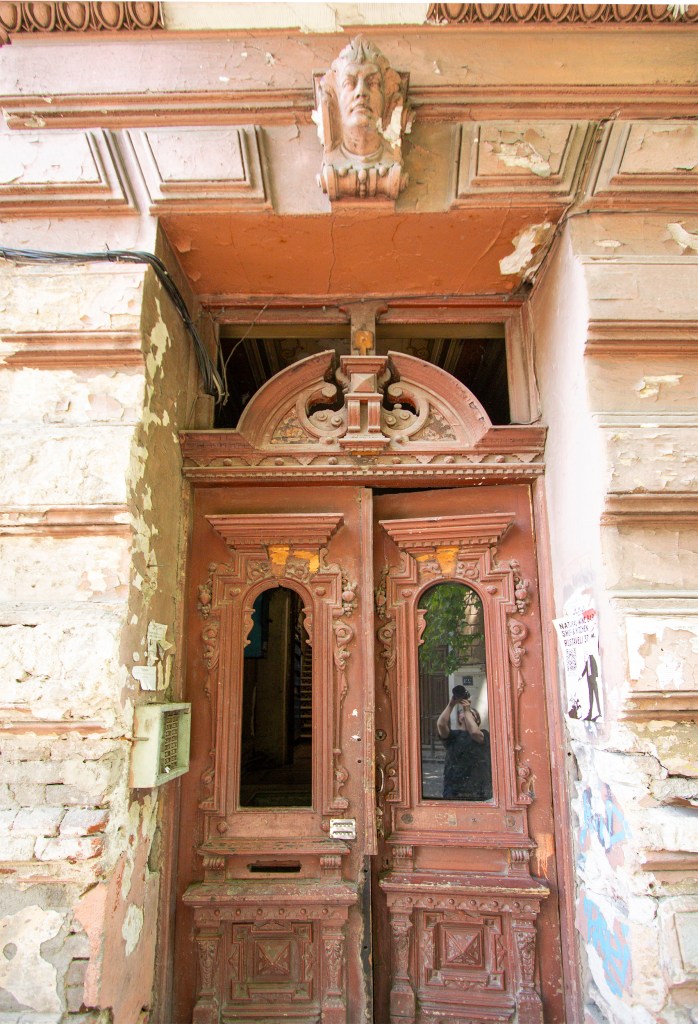
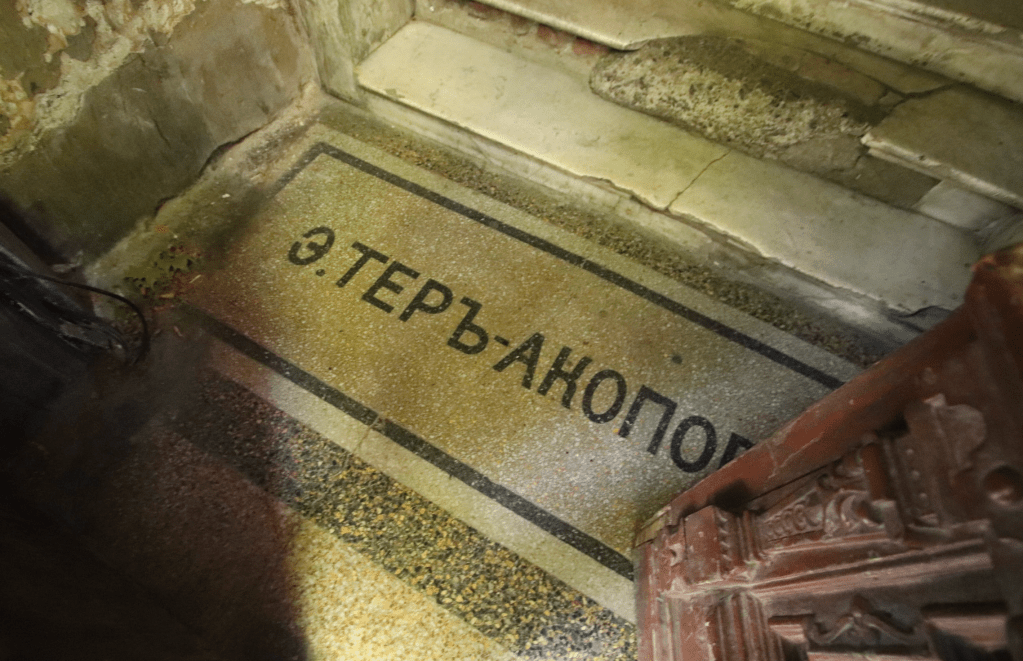
The entrance ensemble survives and is readable in everyday use. At the threshold, Ter-Akopova’s name is set in inlaid terrazzo, i.e. a cast-in-situ cement matrix with fine marble chips, bordered by contrasting bands; the black letters are a darker terrazzo mix poured into letter molds and then ground and polished flush.
There is also a gold-lettered signature of the Italian craftsman Angelo Andreoletti ties the stair and marble/terrazzo finishes to his workshop. Stair finishes, painted wall and ceiling panels, crisp door carpentry, and cast-iron elements (including a lamp stand at the portal) continue the decorative program. Several present-day venues in the building allow a courteous glimpse of these interiors.
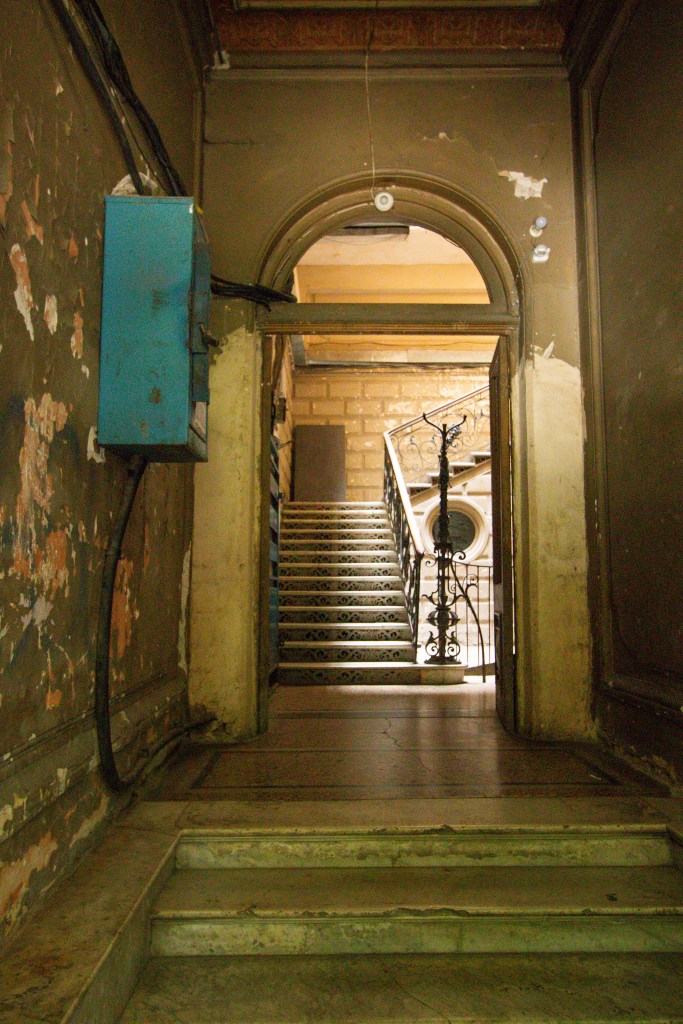
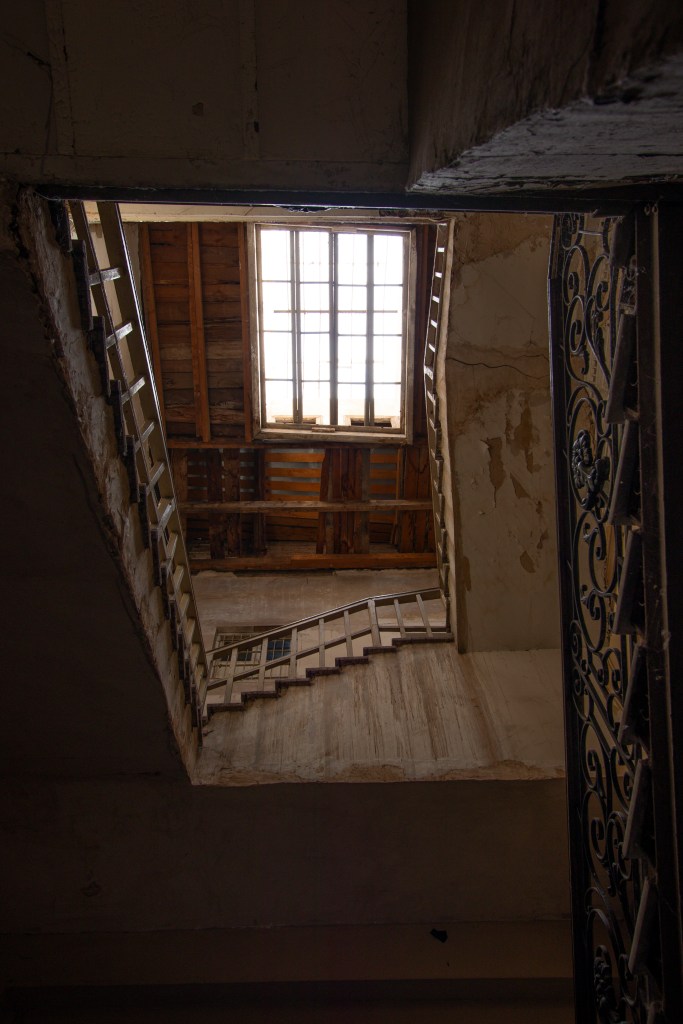

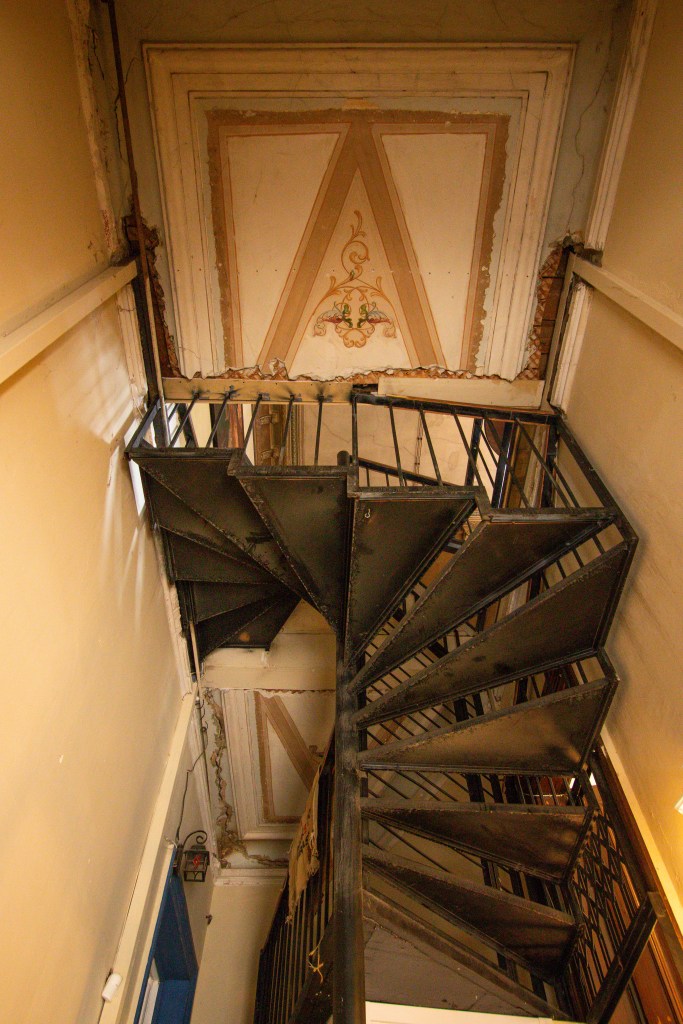
In the 1930s the originally two-storey house was raised by one storey – an early-Soviet adaptation that lifted the roofline while preserving the late-imperial order below. Now, like many other Sololaki buildings, Ter-Akopova house requires careful restoration. Geological and hydrological conditions on the slope (variable ground, moisture, drainage), together with seismic vulnerability, stress brick-and-stucco envelopes and thin lime plasters; mascarons and other sculptural details are especially susceptible to salt, vibration, and ad-hoc fixings. Fragmented ownership, dense services, and commercial pressure on ground floors further complicate coherent repair. Ter-Akopova’s house concentrates these issues in one address: a refined 19th century front, valuable entrance finishes, a later heightening – and the need for structural consolidation, materials conservation, and specialist craft to keep both facade and interior ensemble in service.
Sources and Further Reading
Beridze, Vakhtang. Architecture of Tbilisi, 1801–1917, 2 vols. [tbilisis khurotmodzghvreba, 1801–1917]. Tbilisi, 1960–1963. [in Georgian]
Kvirkvelia, Tengiz. Old Tbilisi [dzveli tbilisi]. Tbilisi, 1984. [in Georgian]
Kutateladze, Tea. Interiors of Residential and Public Buildings in Tbilisi, 19th–20th Centuries [satskhovrebeli da sazogadoebrivi shenobebis int’erierebis monument’ur-dek’orat’iuli perts’era k. tbilisshi XIX–XX sauk’uneebis mijnaze]. Tbilisi, 2015. [in Georgian]
Meskhi, Maia. Architectural-feature Analysis, Problems and Paradigms of Sololaki Area’s Spatial-Volumetric Structure [sololak’is sivrtsit – motsulobiti st’rukt’uris arkit’ekt’urul – mkhat’vruli analizi, problemebi da paradigmebi. Tbilisi, 2019. [in Georgian].
Chanishvili, Nino. Nineteenth-Century Architecture of Tbilisi as a Reflection of Cultural and Social History of the City. FaRiG Rothschild Research Grant Report, 2007.
Tsintsadze, Vakhtang. Tbilisi: Architecture of the Old City and Residential Houses of the First Half of the 19th Century [Tbilisi. Arkhitektura starogo goroda i zhilye doma pervoi poloviny XIX stoletiia]. Tbilisi, 1958. [in Russian]
Wheeler, Angela. Architectural Guide: Tbilisi. 2023.
text and photos by Elena Lisitsyna
 bureau MARKA