
also known as Jagetian House
location: 41.706431847296216, 44.803385761806524
architect: Pavel Zurabyan
date: 1909
illustration focus: courtyard; shushabandi
If you would like to explore Chugureti beyond this building, our partner FAHU travel offers a walking tour of the district’s entrance halls, including a visit to the former Apollo cinema; more details here.
In the early twentieth century, Chughureti – Tbilisi’s rapidly evolving left-bank district – became home to a unique architectural project: a pair of mirror-image mansions known as the Jagetian houses. The project was initiated by a wealthy Armenian merchant, Alexander Jagetian, for his two sons.
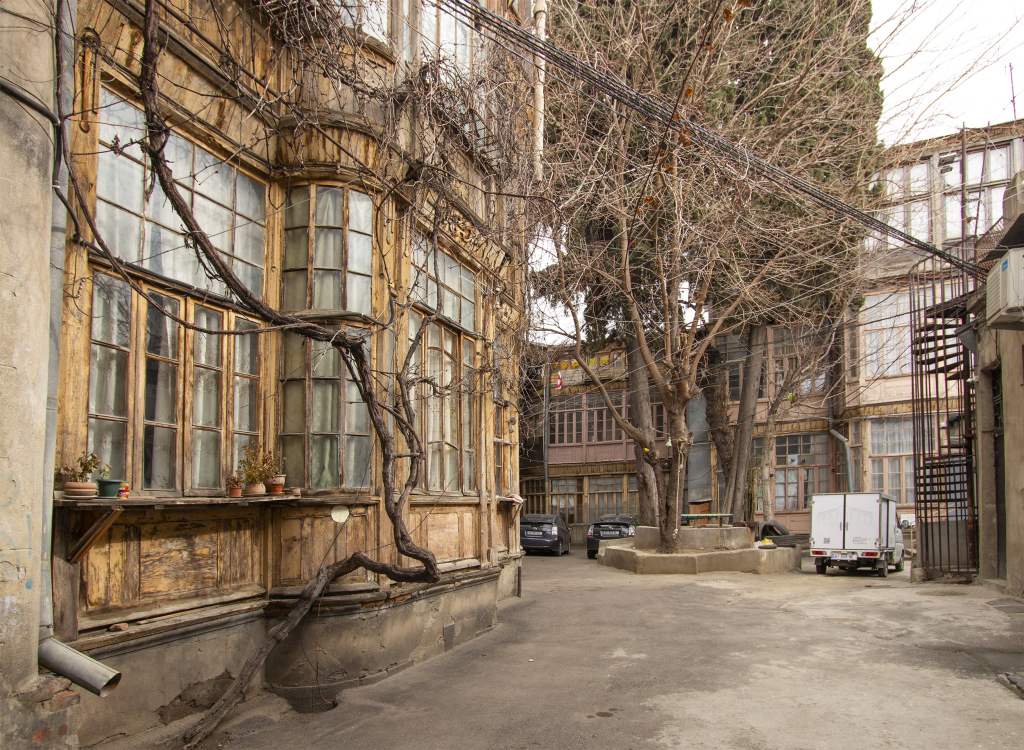
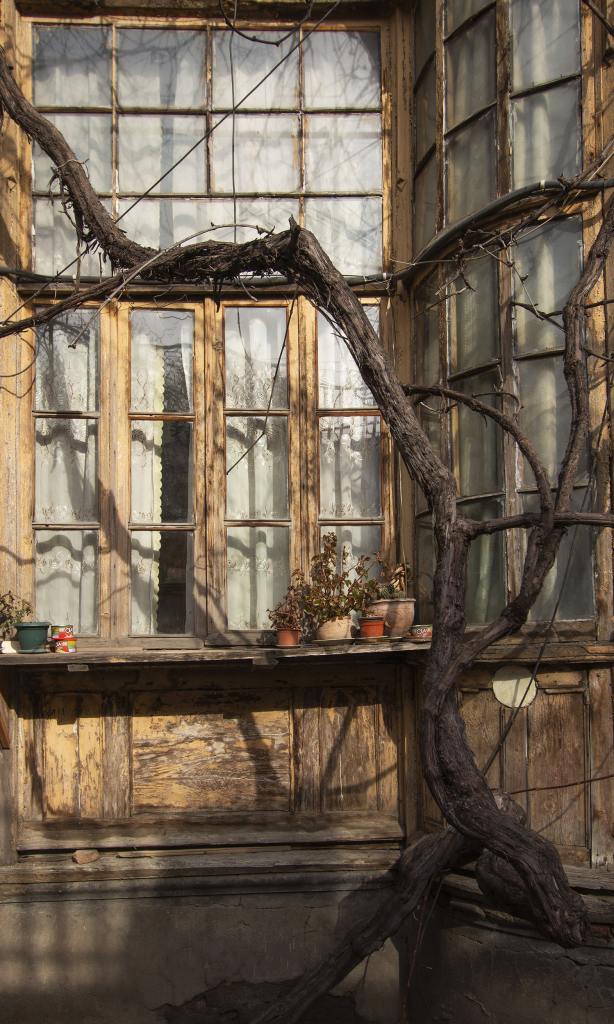
What you see in the coloring-book illustration is the courtyard elevation of the twin houses and a lower corner house that links the two main volumes. The prominent elements are loggias, or enclosed glass balconies. In Georgian they are called shushabandi (შუშაბანდი): the word fuses shusha “glass” (from Persian šīše) with the element -bandi“enclosure/fastening,” a productive Persian suffix also familiar from terms like yazdi-bandi. Shushabandi create a luminous threshold between inside and out – distinct from Tbilisi’s open wooden balconies yet fully part of the city’s communal courtyard life. It is no exaggeration to say the Jagetian shushabandi are special: their gently wavelike plan is unusual for Tbilisi and shape a uniquely charming courtyard.

If we turn to the street elevation – more precisely, to the two paired street fronts – the façades present a notable Art Nouveau character. The architect for both houses was Pavel Zurabyan (1874–1942), a Shushi-born Armenian who served as district architect of Tiflis (1899–1917) and worked widely across the Caucasus. In Tbilisi his portfolio ranges from the Nersisian Seminary to the Vologda-Kama Bank branch on today’s Gudiashvili Street, pavilions of the Avlabari medical campus, the Red Cross hospital on Uznadze Street, and numerous income houses for the city’s Armenian bourgeoisie – including the Jagetian houses. In the late-Imperial system, the title “engineer” denoted a fully licensed building professional with authority to sign projects and supervise works.

Fortunately, the State Historical Archive of Georgia preserves the initial permit set for the houses (1909). The document of that type was usually issued at the Tiflis City Council for private construction in imperial Tbilisi. On that drawing the street elevation reads as restrained Neo-Classicism. The executed façade, however, is noticeably different: richer and more plastic, with decoration readily aligned with Art Nouveau. There are clear constructive and compositional changes: deep two-tier central balconies on heavy consoles were added at the second and third floors; segmental arches group the upper-story windows; and curving, sculptural attic forms anchor the ends. Even the window rhythm differs from the permit drawing—where five equal upper openings become four broader bays in the built version, with the center articulated more finely. Unfortunately, no other project sheet of the houses has surfaced, so that one can only suppose there was later rework of street elevation that suited Art Nouveau fashion of the early 20th century.

archival plan explanations
The permit sheet contains the standard late-imperial set: a street elevation, floor plans for each twin half, a longitudinal section, and a small site sketch showing the building line along Elizavetinskaya Street (today Tsinamdzghvrishvili). On this sheet, red indicates masonry cut in plan/section; yellow marks timber floors; blue blocks show stoves, chimneys, and flues; pink denotes elements beyond the cut or neighboring property. The project is signed by Pavel Zurabyan with the professional title “engineer” – a late-Imperial architectural-construction designation, parallel to “architect” track.
Another distinctive feature of the houses is their painted entrance halls. One was repainted in Soviet times; the other preserves its murals, largely floral in theme. Notably, the cycle is signed and dated on the paint layer: “J. Poznań, 1911.” The inscription most likely records the painter’s name and suggests a Polish origin or training.
Today both residential buildings and their associated coach house are registered as cultural-heritage monuments under No. 5264 and No. 5265. The coach house has been adapted for a wine shop, while the residential buildings continue to function as communal housing. The courtyard – with its magnificent shushabandi – remains one of the city’s most evocative spaces, a favorite setting for photography and video.
Sources and Further Reading
National Archives of Georgia (NAG). Fond 192. Series 8a. File 8507.
Beridze, Vakhtang. Architecture of Tbilisi, 1801–1917, 2 vols. [tbilisis khurotmodzghvreba, 1801–1917]. Tbilisi, 1960–1963. [in Georgian]
Kvirkvelia, Tengiz. Old Tbilisi [dzveli tbilisi]. Tbilisi, 1984. [in Georgian]
Kutateladze, Tea. Interiors of Residential and Public Buildings in Tbilisi, 19th–20th Centuries [satskhovrebeli da sazogadoebrivi shenobebis interierebi, XIX–XX saukuneebi]. Tbilisi, 2015. [in Georgian]
Meskhi, Maia. Architectural-feature Analysis, Problems and Paradigms of Sololaki Area’s Spatial-Volumetric Structure [sololak’is sivrtsit – motsulobiti st’rukt’uris arkit’ekt’urul – mkhat’vruli analizi, problemebi da paradigmebi. Tbilisi, 2019. [in Georgian].
Tsintsadze, Vakhtang. Tbilisi: Architecture of the Old City and Residential Houses of the First Half of the 19th Century [Tbilisi. Arkhitektura starogo goroda i zhilye doma pervoi poloviny XIX stoletiia]. Tbilisi, 1958. [in Russian]
Wheeler, Angela. Architectural Guide: Tbilisi. 2023.
text and photos by Elena Lisitsyna
 bureau MARKA