
location: 41.705206085136204, 44.79125437549243
date: 1905
illustration focus: courtyard
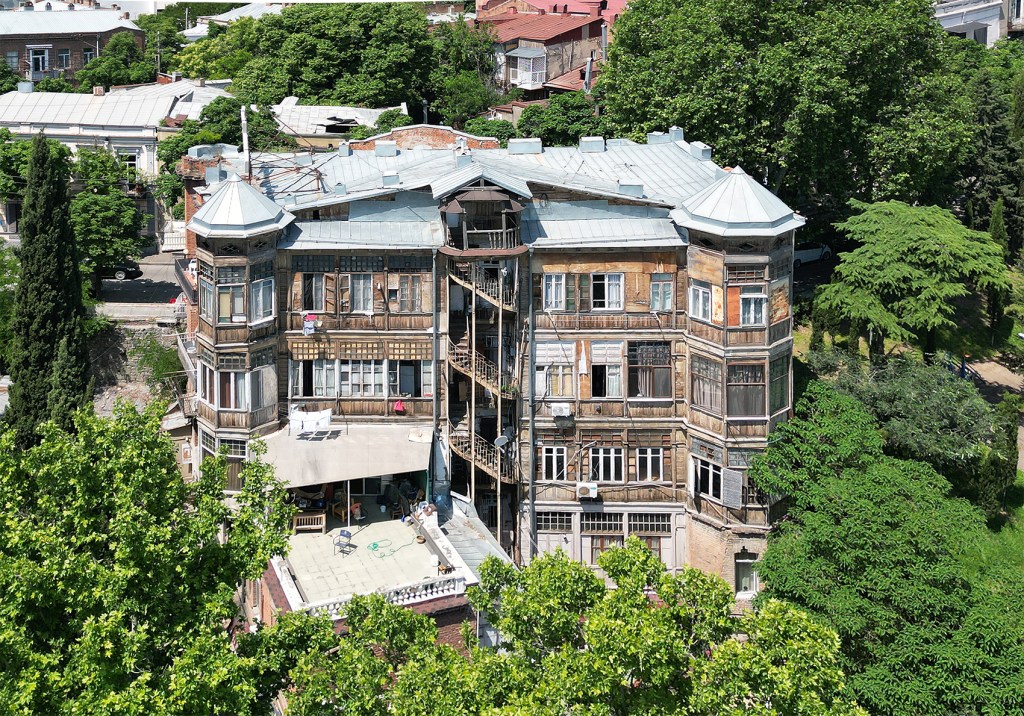
The house at 7a Leo Kiacheli Street stands where the Vera slope drops toward the Mtkvari River, and it reads entirely differently depending on which side you face. Street-side, the faсade is a restrained, two-storey piece of late-imperial urban fabric: plain plastered walls and a small iron balcony centered over the entrance. Turn to the river, however, and the same structure opens to five storeys and effectively becomes its own principal faсade, rising above a pocket of greenery. Here the building turns to timber and glass: a tall, continuous shushabandi (a glazed wooden gallery) spans the elevation and is framed, left and right, by octagonal corner bays capped with conical roofs. At the very center an external spiral stair runs the full height of the house. It is both everyday circulation for residents and a defining ornament – the element one remembers on leaving. On the right, a small two-storey rear wing adjoins this elevation; its flat roof, enclosed by a balustrade, serves as a terrace. Below the terrace lies Samaia Garden, one of Vera’s surviving green pockets that anchors the building in the district’s older landscape. Much original fabric survives in the rear galleries and window bands – early glazing and timber doors with simple geometric inserts – while the street entrance retains terrazzo paving and a marble stair.
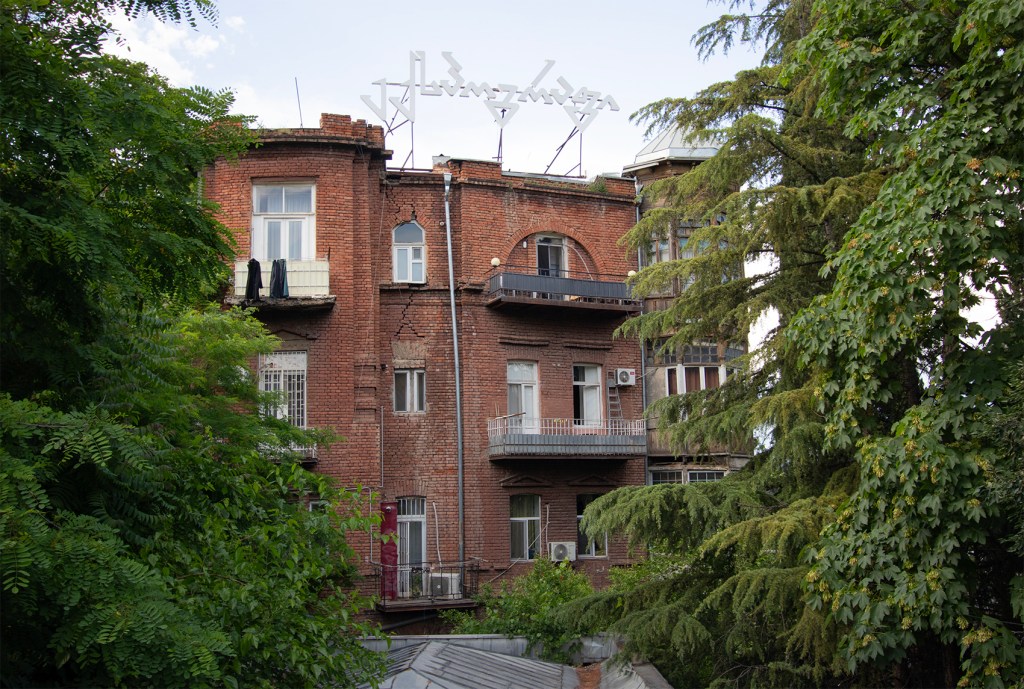
This riverward elevation functions, in practice, as the house’s public face – yet it is difficult to examine closely, since there is no level ground directly in front of it; one perceives it from below – or, as in this coloring book, by studying its photographed or drawn details. Compositionally, it is not so typical for the period: the rear is not an internal, non-public side but a carefully modelled facade, fully exposed to those moving along the Vere Descent. In other words, features of local courtyard architecture – an open spiral stair binding the shushabandi galleries – persist behind a polite, regulation-friendly street front, yet the “back” is turned outward, almost playing with official rules; the topography makes that inversion possible. Unlike many houses compressed within perimeter blocks, this one is free-standing and reads on all four sides. Even the right-hand elevation can be read as a facade from certain viewpoints: though in bare brick, it is broad and pierced with windows.
Vera district itself grew from gardens and dukhans (taverns) on the right bank of the Mtkvari river into a late-imperial neighborhood most intensively in the late 19th and early 20th centuries. The name derives from the Vera River, which joins the Mtkvari at the district’s northern edge. A key moment came with the erection of the iron Vere Bridge in 1882–1884 (today’s Galaktioni Bridge) and the cutting of the Vere Descent (rus. Vereiskii spusk; today Mikheil Javakhishvili Street), which established a transverse link across the slopes between the city’s main north–south axes. In 1884 a market was shifted here from Erivani/Erivan Square (today’s Liberty Square); a tram soon followed, and the area thickened with shops and traffic. In the same decades Vera’s orchards gave way to brickworks, sawmills, and carpentry yards serving the city’s expansion, while medical facilities took advantage of the district’s edge location. Lower Vera (around present-day Kostava Street) filled with petit-bourgeois housing and medical staff – near the maternity hospital under the patronage of Grand Duchess Olga Feodorovna whose 1875 building is the precursor of today’s Chachava Clinic – while upper Vera (around and above Vasil Barnovi Street) was more mixed, with Russian craftsmen and military officers among working-class residents.
The street’s name traces the district’s shifts: in imperial directories the lane appears as Korganovskaya (also Karganovskaya), named for a local entrepreneur; in the early Soviet years it was retitled Communist Korganov Street; since the 1960s it has borne the name of the writer Leo Kiacheli. As for No. 7a itself, its early history remains partly opaque. Residents recall a small private maternity hospital on an upper level in the 1910s, but there is no documentary evidence. Local recollections sometimes link this to Dr Sebastianov; absent proof, the attribution should be treated as provisional. A 1925 city guide does record a State “Infants’ Home No. 1” at “Communist Korganov Street, 7,” indicating that this address cluster was tied to maternal-and-childcare institutions in the early Soviet years. Later, the interwar mass-defence society OSOAVIAKhIM occupied premises here—a metal plaque with the organisation’s emblem still survives beside the entrance. During the formation of the adjacent square (today Rose Revolution Square), structural cracks appeared in the building; the structure was subsequently stabilised and repaired by Austrian specialists. Today the house is listed in the Georgian Register of Immovable Cultural Heritage (No. 5022). Taken together, these traces show how a turn-of-the-century residential building absorbed the programmes and signage of the 1920s–30s, endured major late-Soviet construction works, and yet preserved its early architectural language.
Sources and Further Reading
Ministry of Culture and Sports of Georgia. Heritage Register entry for 7a Leo Kiacheli Street (No. 5022). Available at: memkvidreoba.gov.ge
Akimov, Anton. Histories of Tbilisi Houses [Istorii domov Tbilisi]. Tbilisi, 2023. [in Russian]
Beridze, Vakhtang. Architecture of Tbilisi, 1801–1917, 2 vols. [tbilisis khurotmodzghvreba, 1801–1917]. Tbilisi, 1960–1963. [in Georgian]
Chanishvili, Nino. Nineteenth-Century Architecture of Tbilisi as a Reflection of Cultural and Social History of the City. FaRiG Rothschild Research Grant Report, 2007.
Wheeler, Angela. Architectural Guide: Tbilisi. 2023.
text by Anna Efimova and Elena Lisitsyna
photo by Elena Lisitsyna
 bureau MARKA