
location: 41.68939758506589, 44.80411400200982
date: 19th century
illustration focus: street view
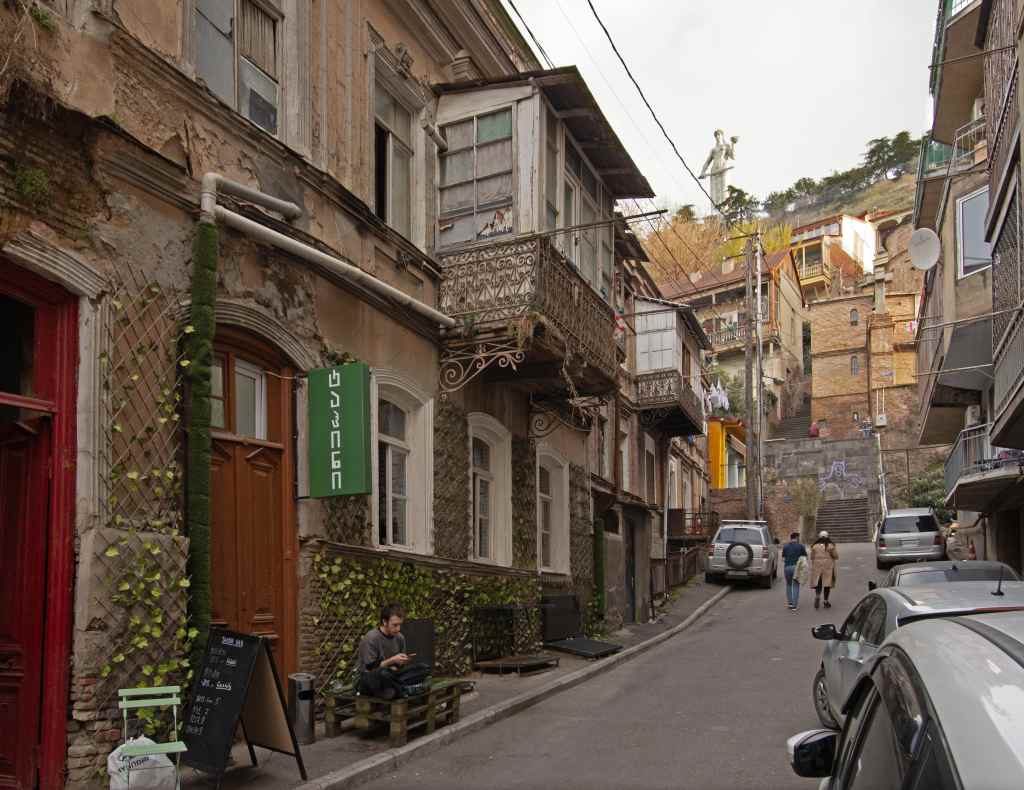
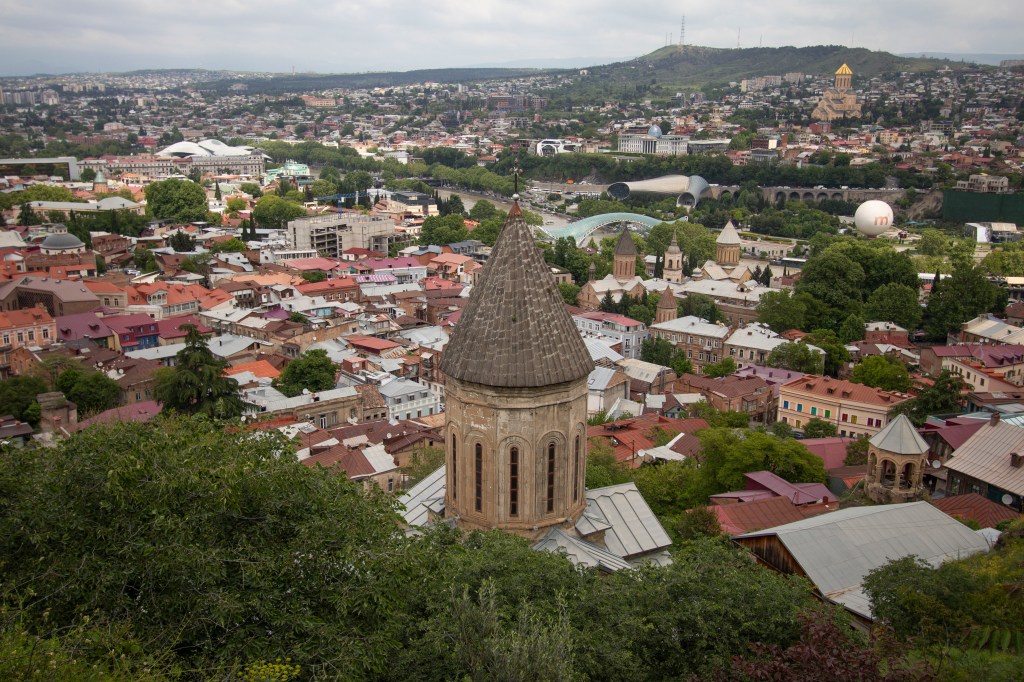
Betlemi Rise threads uphill through the Betlemi micro-quarter on the Kldisubani slope, where the city narrows into terraces, retaining walls, and stone steps on the way to the Upper Betlemi church and, higher still, the Mother of Georgia. In Tbilisi usage, Betlemi is the local form of “Bethlehem,” taken from the names of the two churches in the quarter – so the toponym refers to the Holy Land through those dedications. A short walk still reads the district’s chiefly 18th–19th century layers: churches, lane-stairs, retaining walls with springs set in arched niches, and a compact weave of dwellings – among Old Tbilisi’s most concentrated historic ensembles. Moreover, the quarter contains the Atashgah, a Zoroastrian fire temple of the Sasanian period (3th–7th centuries AD) – a rare survival in the South Caucasus.
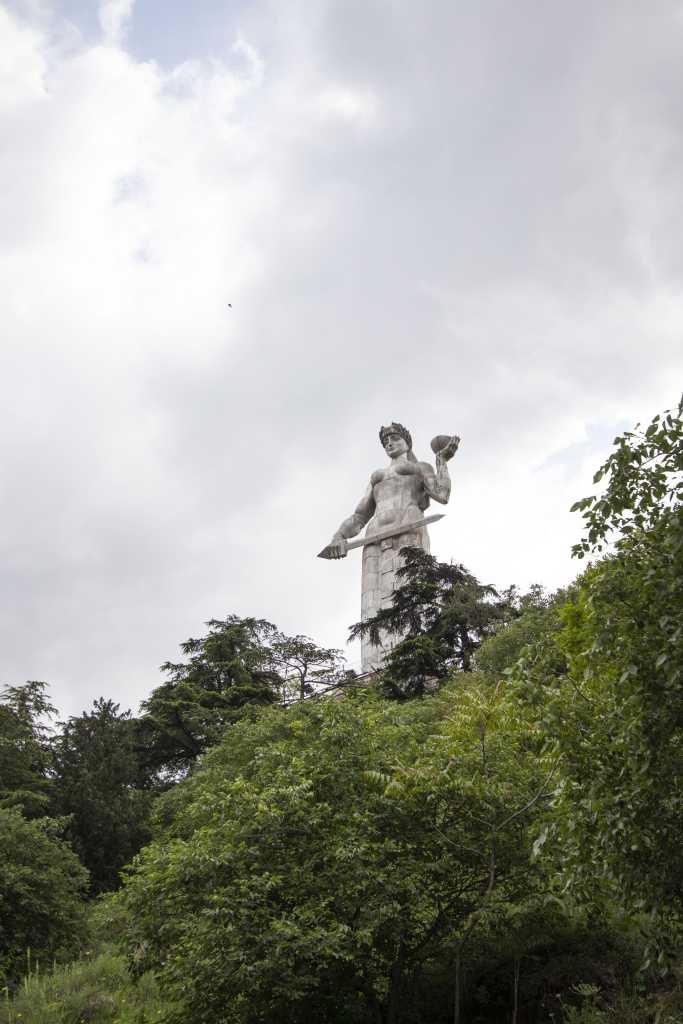

The illustration in the coloring book looks up the street-stair, with Nos. 2 and 4 in the foreground and, beyond them, smaller houses stepping up the Kldisubani slope. Nos. 2 and 4 are fairly ordinary Europeanized, 19th century two-story street houses – plain brick and plaster to the front. Farther along the Rise, the character shifts: smaller houses with timber balconies, which signal the entrance into the Betlemi quarter proper to the left as one ascends. The stone street-stair was proposed in 1850 by the Tiflis architect Timofey Beloi. The builders were local amkari – Tbilisi’s craft masters – who executed the work as a civic donation to the city.
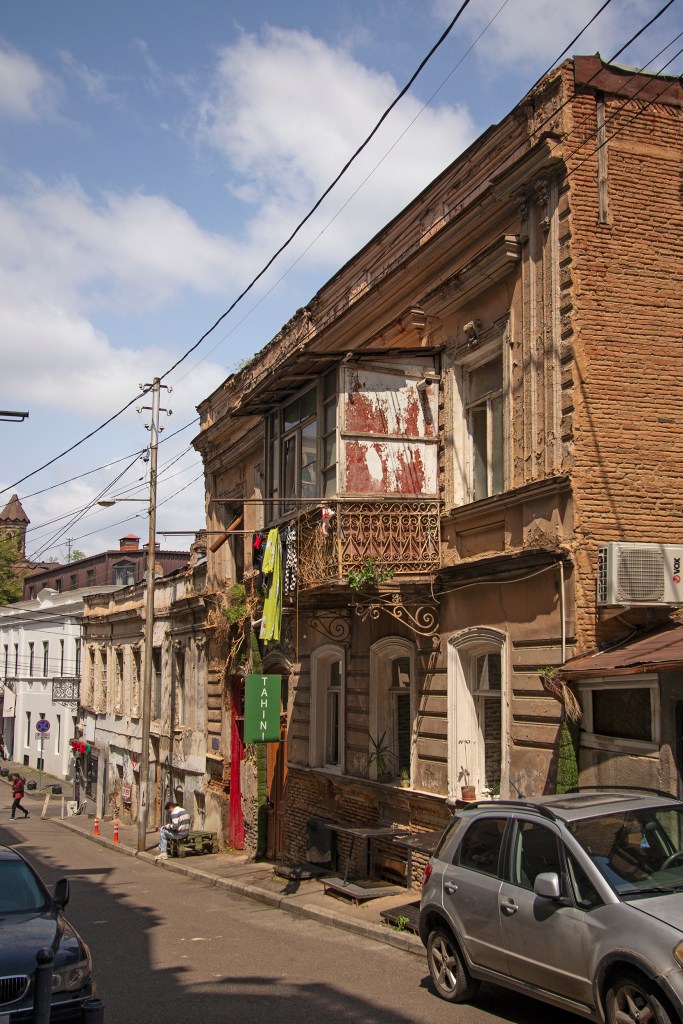
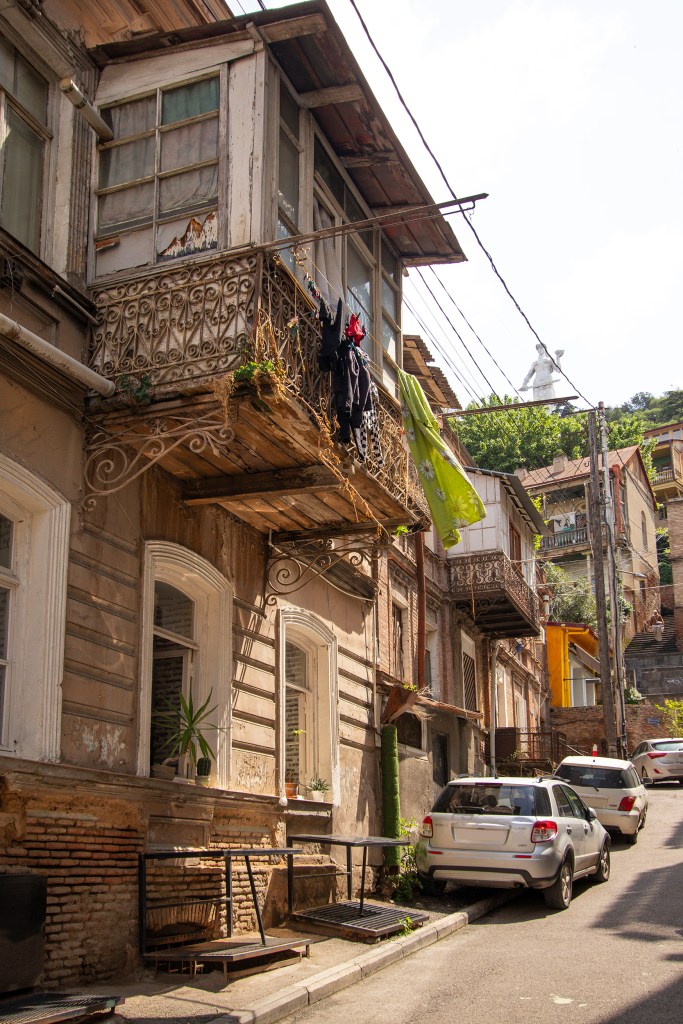
Beyond the Rise, the Betlemi Quarter continues the web of street-stairs with housing exceptional for what survives in Tbilisi today. From the 19th century onward, Russian imperial regulation pushed the regional capital toward a Europeanized plan with strictly defined facades, leading to extensive rebuilding and the near-loss of medieval domestic fabric and street layouts across the city. By contrast, Betlemi’s lower floors preserve a continuous late-medieval layer (17th–18th centuries) – basement rooms with lancet or barrel vaults, wall niches, and spherical “coolers” – so that an “older city” endures below street level. This layer is legible in several 18th century dwellings that have remained almost intact – 11 Askana Street (lower wing); 5 and 16B Betlemi Ascent. These houses are especially valuable as tangible evidence of two late-medieval Tbilisi dwelling types: the flat-roofed suite of rooms and the tower-like dwelling. Overall, the quarter’s housing reads chiefly as a mid-19th century layer: two-story courtyard houses adapted to tight plots and changes in grade. Here the canonical Tbilisi elements concentrate: architraved or arched wooden balconies (semicircular, trefoil, or keel), the shebeke stained-glass technique, and plaster/stucco profiles executed by local craftsmen. Together these layers explain the quarter’s grain: small plots sequenced by stairs and landings, masonry and timber answering the slope, and a yard-facing domestic architecture whose incremental repairs and additions have carried the fabric from the eighteenth century into the modern city.
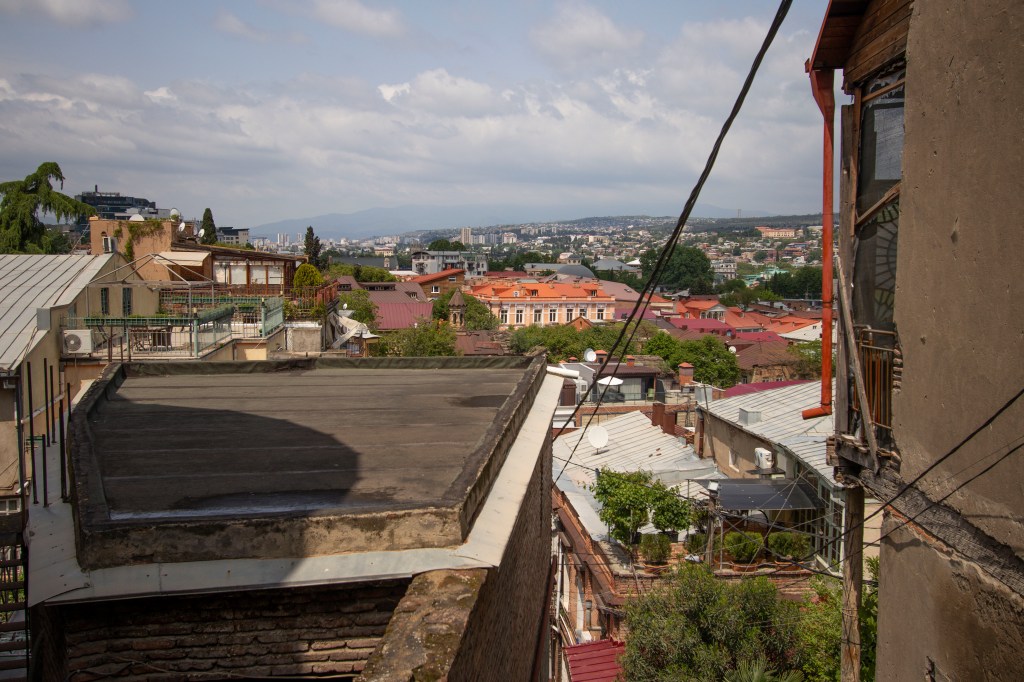
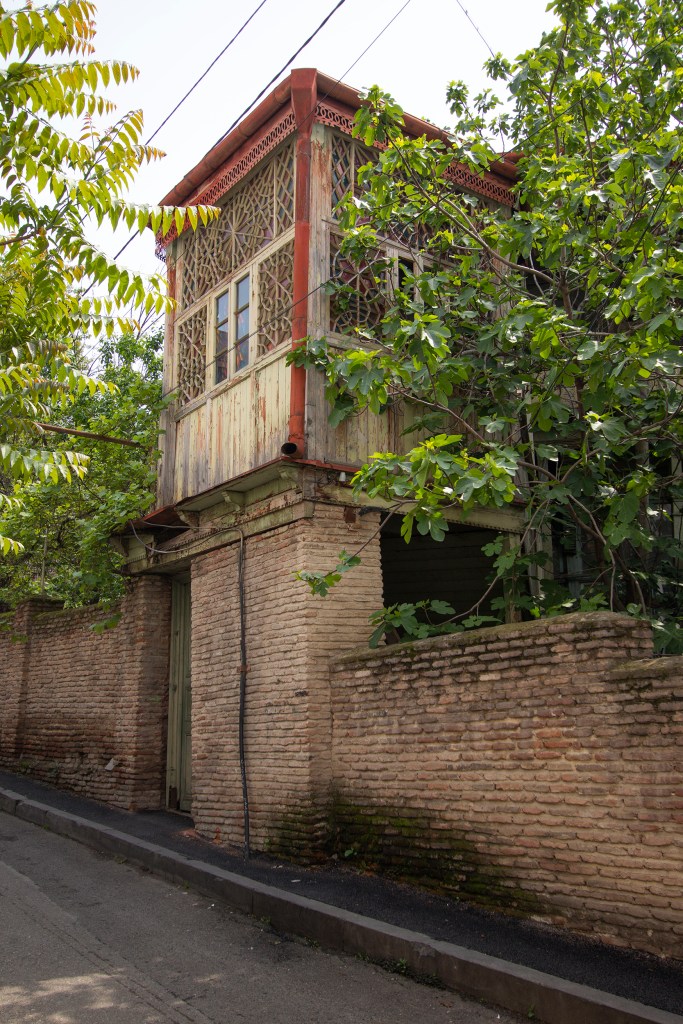
The Betlemi Quarter is, however, more than a historic urban fabric; it is a case study in deeply participatory conservation, with residents working in close collaboration with heritage specialists. When ICOMOS Georgia launched “Save Old Tbilisi” in 1999, Betlemi became an early focus. With funding and technical support from the Norwegian Ministry of Foreign Affairs and the Norwegian Directorate for Cultural Heritage (Riksantikvaren), the team undertook several years of analysis and fieldwork, followed by conservation works (c. 2006–2010). The approach paired fabric repair with skills and participation: training in joinery and glazing, works carried out by local crews, and decisions taken with residents. A touchstone of those efforts stands at 3 Betlemi Street, the so-called “kaleidoscope house,” where the entrance and balconies were restored: the damaged wooden musharabi (projecting balcony-screen with stained-glass lattice) was dismantled and reassembled, and surviving panels were conserved in the Caucasian shebeke technique (small glass pieces set in a dowelled timber lattice without nails or glue) amid a shortage of suitable glass that prompted targeted training and Norwegian wood-conservation guidance.
The conservation program also focused on the stone street-stair (Betlemi Rise) up to the church. By the late 20th century the steps had decayed and become hazardous, yet they remained the preferred route for parishioners of the Betlemi church and for residents crossing the quarter toward the Old Town. In the 2000s, as part of a wider revitalisation program for the quarter, the area was substantially rehabilitated. The broken basalt treads were replaced in kind and fixed by a traditional method that clamps the slabs with molten-lead joints. Stairs’ historical supporting walls were rebuilt on traditional lines. The church platform was repaved with a compatible mix of basalt slabs (used throughout Betlemi’s street-stairs) and river stones (traditional for walkways), and the small garden by the platform – something residents had long wanted – was laid out as a contemporary insert without pretending to be original. In this sense, the final ascent to the Betlemi churches was not “restored” in a pictorial way, but carefully repaired – preserving the historical fabric and spatial organisation while meeting contemporary community needs. In this sense, the final ascent to the Betlemi churches was not “restored” in a pictorial way, but carefully repaired – preserving the historical fabric and spatial organisation while meeting contemporary community needs.
Thus, Betlemi offers a precise way to speak about the vernacular city. In architecture and heritage practice, “vernacular” denotes built forms that evolve within a community, using local materials and know-how transmitted informally rather than codified by academy or state. In Tbilisi, the typical one-storey dwellings largely disappeared under nineteenth-century imperial policies that Europeanized plans and fixed street façades and rooflines. Yet those rules did not erase local craft: courtyards – left largely unregulated – remained the centers of neighborhood life, where vernacular elements continued to develop – balconies and galleries, external stairs, stained glass, and fine plasterwork. Such features grew through small decisions and additions, negotiated at the boundary between officially regulated urban fabric and the choices of a household or neighborhood. In the late-imperial and Soviet eras, top-down taste often privileged “representative” styles and eroded everyday fabric that did not fit those rubrics. By contrast, the Betlemi project treated authenticity as both material and social: repairing the fabric while enabling the people who live here to define what mattered. We hope you will wander Betlemi’s passages and read, in situ, the atmosphere and the residents’ effort to sustain Tbilisi’s unique urban heritage here.
Sources and Further Reading
ICOMOS Georgia. Tbilisi, Kala. Betlemi Quarter Revitalisation. Programme Report, 2000-2010. Tbilisi, 2011.
ICOMOS Georgia. Bethlehem neighborhood conservation plan – Intervention Guidelines [betlemis ubnis k’onservatsiis gegma – charevis sakhelmdzghvanelo printsipebi]. Tbilisi, 2023. [in Georgian]
Beridze, Vakhtang. Architecture of Tbilisi, 1801–1917, 2 vols. [tbilisis khurotmodzghvreba, 1801–1917]. Tbilisi, 1960–1963. [in Georgian]
Chanishvili, Nino. Nineteenth-Century Architecture of Tbilisi as a Reflection of Cultural and Social History of the City. FaRiG Rothschild Research Grant Report, 2007.
Kvirkvelia, Tengiz. Old Tbilisi [dzveli tbilisi]. Tbilisi, 1984. [in Georgian]
Tsintsadze, Vakhtang. Tbilisi: Architecture of the Old City and Residential Houses of the First Half of the 19th Century [Tbilisi. Arkhitektura starogo goroda i zhilye doma pervoi poloviny XIX stoletiia]. Tbilisi, 1958. [in Russian]
Wheeler, Angela. Architectural Guide: Tbilisi. Berlin: DOM publishers, 2023.
NPLG Wiki Dictionaries. Beloi, Timofey Nikitich [beloi t’imote nik’it’as dze]. Available at: nplg.gov.ge [in Georgian]
text by Anna Efimova and Elena Lisitsyna
photo by Elena Lisitsyna
 bureau MARKA